
Website Redesign Cost: A B2B Budget Guide

Website redesign cost for a B2B company usually runs from a few thousand dollars to well into five figures. That range is too wide to plan around, so this guide breaks down what sits behind it: what you are paying for, what pushes a project up or down, and what to check in a proposal before you sign.
We use Align's own price bands as the worked example, because they are the only numbers we can stand behind. Other agencies price differently. The questions you should ask them are the same.
Quick Answer: What Does a B2B Website Redesign Cost?
At Align, website projects fall into three bands:
| Band | Price | Typical fit |
|---|---|---|
| Basic | $2,000 to $5,000 | A smaller marketing site with a clear structure and content mostly in hand |
| Advanced | $5,000 to $8,000 | More pages and templates, content to rewrite or migrate, a few integrations |
| Premium | $8,000 and up | Large sites, several languages, complex integrations or a full content migration |
A marketing site of ten to twenty pages usually takes ten to fourteen weeks from kickoff to launch. A redesign adds work at both ends: an audit of the current site before design starts, and migration checks around launch.
Four things decide where a project lands: the number of templates, how much content has to be written or moved, the integrations, and how much of the old site's search traffic has to be protected. If you want a band for your own site, send Align the current address and we will tell you after a first look.
What a Website Redesign Includes
"Redesign" can mean refreshing three templates or rebuilding the whole site. The word alone does not tell you which one an agency has priced. Most B2B redesigns include some version of these workstreams:
| Workstream | What it covers | Questions that change the scope |
|---|---|---|
| Audit | Search Console, analytics and a crawl of the current site | Which pages bring traffic and leads today? |
| Content inventory | A decision for every page: keep, rewrite, merge or retire | Who writes, edits and approves the copy? |
| Structure | The new sitemap, navigation and redirect map | Are URLs changing? How many? |
| UX and UI design | Wireframes, then the visual design for each template | How many templates and review rounds? |
| Development | Front end, CMS, forms and tracking | Which CMS, and which systems does it connect to? |
| Migration | Pages, images and metadata moved across | Is migration in the quote or left to your team? |
| Launch and support | Redirect tests, the switch, monitoring, training | What happens in the weeks after launch? |
A new website skips the audit, the content inventory and the redirect map. That is the main reason a redesign is rarely cheaper than a new build of the same size, even though the business already has a site.

Every page gets a decision before design starts: keep, rewrite, merge or retire.
The Factors That Move Website Redesign Cost
Templates more than pages
Page count matters, but templates matter more. Forty service pages on one template cost less than ten pages that each need their own layout. When you brief an agency, list the page types (home, service, case study, article, contact) and roughly how many of each.
Content: moved, rewritten or written
Content is where budgets slip most often. Moving existing copy across is quick. Rewriting it for a new structure takes longer, and writing new pages takes longer still. Content also slows approvals: a page that needs legal or technical review takes longer even when the text is short. Decide early who writes what.
Integrations
A contact form that sends an email is simple. A form that feeds a CRM, a booking tool, a client portal or a product database is not. Each integration adds design, build and testing time. List them up front, and name who owns access to each system.
Protecting search traffic
If the current site ranks and brings in leads, the redesign has to carry that across. That means an audit, a redirect map and checks after launch. When we rebuilt align.vn, the redirect map alone held 654 old addresses. This work is invisible in the finished design, and it is the part a cheap quote usually leaves out. Our guide on how to redesign a website without losing SEO walks through it step by step.
Languages, accessibility and testing
Every extra language adds content, QA and sometimes layout work. Testing across phones, browsers and forms takes time too. Agree on the standard: WCAG 2.2 for accessibility, and Core Web Vitals measured on a phone for speed.
The state of the old site
A site that was hacked, or one held together by plugins, can be cheaper to rebuild than to clean. After a hack, we rebuilt Trusted Union's 52-page front end from an empty repository in 17 days instead of patching the old install.
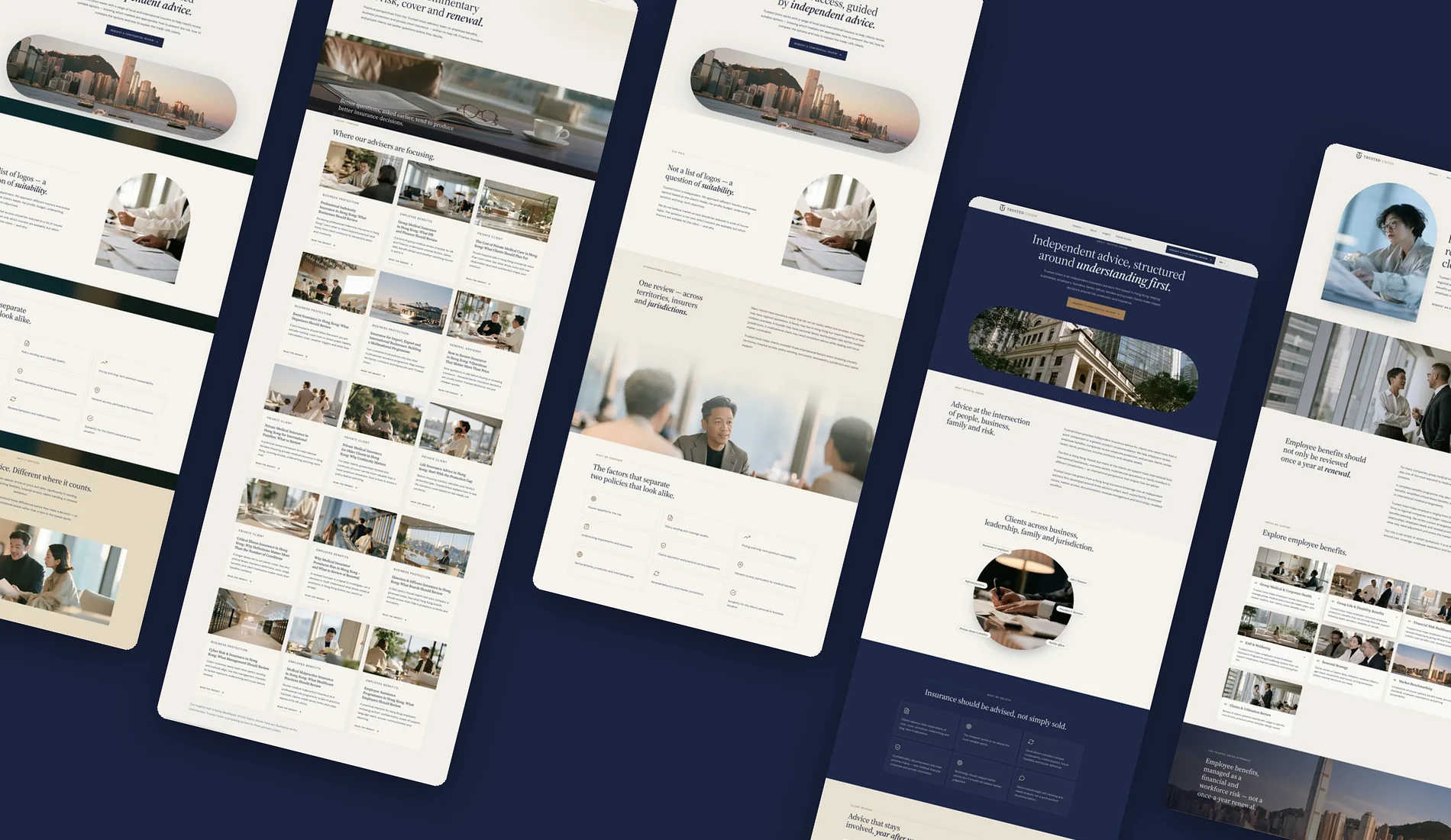
Trusted Union: a 52-page front end rebuilt from an empty repository in 17 days.
Your side of the project
One owner who collects feedback moves faster than five approvers giving conflicting notes. Budget for your team's time as well: content, access, decisions and reviews.
Refresh or Full Redesign?
A visual refresh keeps the structure and the code and changes how the site looks. A full redesign changes the structure, the templates and usually the platform.
A refresh can be enough when the structure still matches what you sell, the site is fast, your team can edit it, and the main problem is that it looks dated.
A full redesign is usually the better spend when the business now sells something different or to different buyers, the site is slow or runs on a stack nobody wants to maintain, or it ranks but does not convert because of its structure.
Data Society is an example of the second kind. Visitors came for one of two services, but the old menu buried both. Align rebuilt the information architecture around the two offers, so a visitor reaches the right one in a click or two. Most of the value came from a clearer path to the pages that mattered, with no extra pages added.
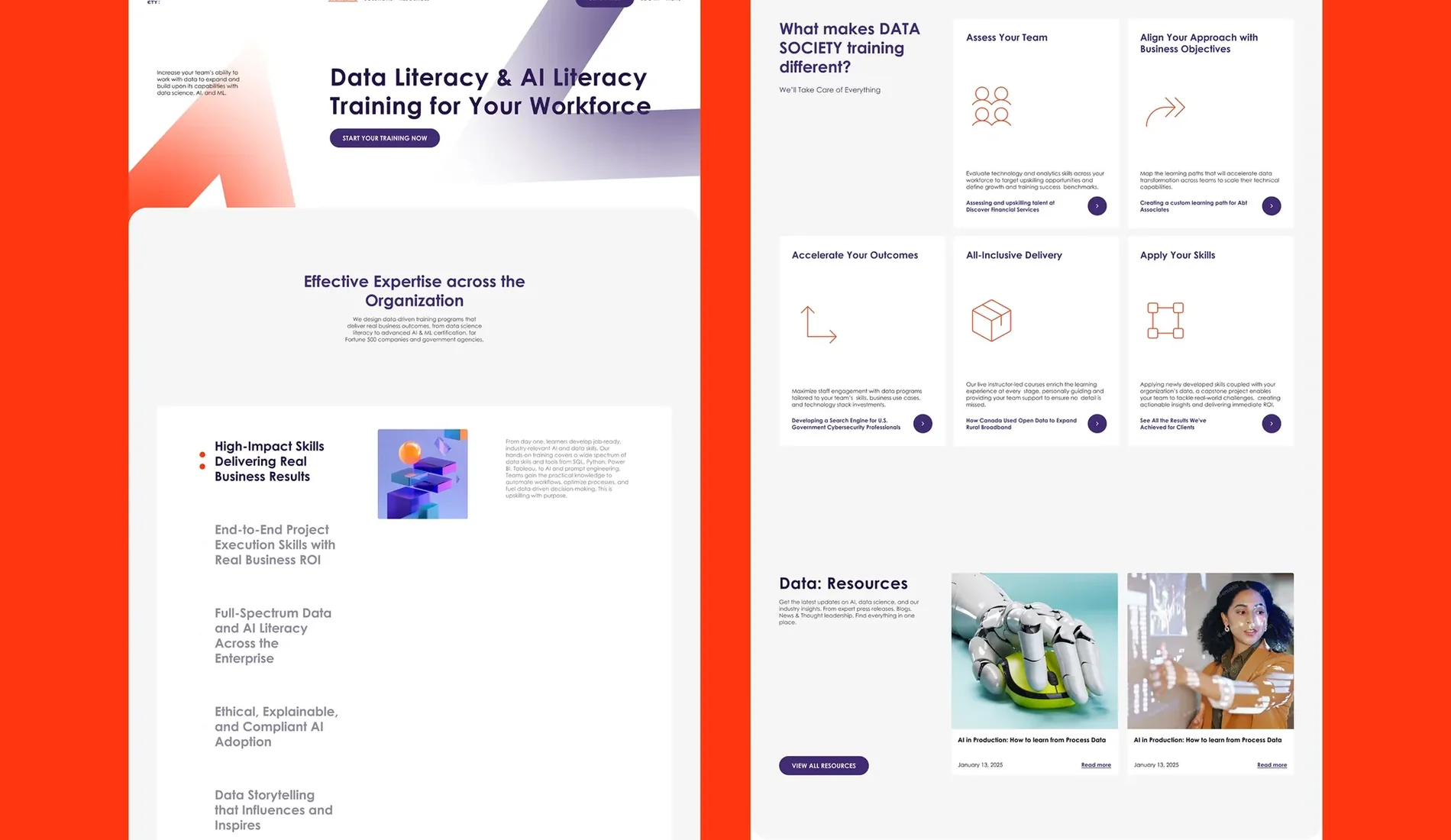
Data Society: the menu was rebuilt around the two offers, so a visitor reaches the right one in a click or two.
Budget Around Outcomes, Not Page Count
Start the budget from the business problem. If buyers do not understand the offer, the money goes into structure and messaging. If the site is a migration, it goes into URL mapping and monitoring. If sales needs better leads, it goes into forms and the CRM handoff.
Then sort every requirement into three groups:
- Essential: protects launch quality and the tasks buyers come to do.
- Valuable: improves the site but can be staged after launch.
- Optional: waits until there is evidence it helps.
This turns trade-offs into decisions instead of an argument about page count. Count the running cost too: a site that needs a developer for every text change costs money every month. At Align, editable regions are agreed at the wireframe stage, and handover includes a written guide for the people who will use the site.
What a Website Redesign Proposal Should Include
Two proposals for "a website redesign" can describe very different projects. Before comparing prices, check that each one answers these questions:
- How many templates are designed, and how many pages are built?
- Who writes, rewrites and migrates the content?
- Is there an audit of the current site and a redirect map?
- Which integrations are included, and which are extra?
- How many rounds of design revision are included?
- Who owns the design files, code, CMS and analytics after launch?
- How are new requirements estimated and approved mid-project?
- What happens after launch: monitoring, fixes, training, a support period?
- What is excluded? Hosting, licences, stock images and copywriting are the usual gaps.
If one quote is much lower than the others, the answer is usually in questions 2, 3 and 9.
Website Redesign Budget Checklist
Use this before you ask for quotes. Agencies estimate faster and more accurately when the brief already answers it.
- The business outcome the new site has to support
- The buyers and the tasks they come to the site to do
- A rough page list, grouped by type
- Who provides or writes the content
- The tools the site has to connect to
- Whether URLs will change, and how much organic traffic is at stake
- Any deadline that cannot move, and why
- A budget range, even a rough one
If several of these are unknown, start with a short discovery phase instead of a fixed build quote.
Frequently Asked Questions
Is a website redesign priced by the number of pages?
Partly. Templates, content work, integrations, migration and testing matter more. A large site built on a few reusable layouts can cost less than a small site with many custom pages.
Should SEO be included in a redesign?
At minimum: structure, metadata, internal links, redirects when URLs change and checks after launch. At Align, on-page SEO is part of every website build. Ongoing SEO (content, links and reporting) is a separate engagement.
How do we avoid surprise costs?
Share known requirements before the estimate, name one decision-maker, read the exclusions and ask for a written change process. Keep a contingency for things nobody knows yet.
What happens after launch?
Your team should know how to edit the site and who to call about problems. Align supports every project for at least three months after launch at no extra cost, and offers monthly maintenance after that if you want it.
Planning a Redesign?
Align plans, designs and rebuilds B2B websites so the new site keeps what the old one earned. See how our website redesign service works, or send us your current site with your goals and constraints. After a first look, we will tell you which band it is likely to fall into.
References
- Google Search Central: Site moves with URL changes
- W3C: Web Content Accessibility Guidelines (WCAG) 2.2
- web.dev: Web Vitals


