
How to Choose a B2B Web Design Agency: 9 Questions to Ask

A B2B website has to explain a complex offer, speak to several people in the same buying committee, connect to sales tools and still let the marketing team publish without a developer. A good portfolio shows that an agency can make things look right. It does not show how the agency thinks, handles risk or works with your team.
This guide gives founders and marketing leads nine questions for choosing a B2B web design agency. We are one of the agencies you might be comparing, so where Align's answer is relevant we give it, and where another kind of partner fits better we say so.
Quick Answer: How Do You Choose a B2B Web Design Agency?
Write down the business problem first, then ask every agency the same nine questions: how they learn about your buyers, how they structure a complex offer, who does the work, when SEO and content come in, what your team can edit, how integrations are handled, what they test, how scope changes are managed and what happens after launch. Score the answers with the table further down. Choose the agency whose answers are specific to your site, not the one with the best-looking homepage.
Start With the Business Problem
Before the first call, write down what is not working. Prospects may not understand the offer. Sales may be explaining by email what the product pages should already say. Visitors may land on useful articles with no next step. The CMS may be so hard to use that every change waits for a developer.
Describe who the site is for, what you want them to do and how you will know it improved. Leave the list of visual features for later. An agency that gets a clear problem can recommend a scope. An agency that gets a vague request can only guess at one.
9 Questions to Ask a B2B Web Design Agency
1. How will you learn about our buyers and sales process?
Ask what the agency needs to know before it proposes a structure. Good discovery covers who influences the purchase, what they ask, what proof they need and when they talk to sales. In B2B, the person who visits the site first is rarely the only one who decides.
Listen for a process that uses your evidence: sales questions, analytics, support requests, customer interviews. Be careful if the agency goes straight to a visual concept.

The first meetings should be about your buyers and your sales process, not colours.
2. How will you structure a complex offer?
Ask how the agency would organize your services, products and industries. Ask for sitemaps or page flows from past work, not only finished homepages.
Data Society is a good test case. Its visitors came for one of two services, but the old menu buried both. Align rebuilt the information architecture around the two offers so a visitor reaches the right one in a click or two. Ask any agency to walk you through the decisions behind a case study like that.
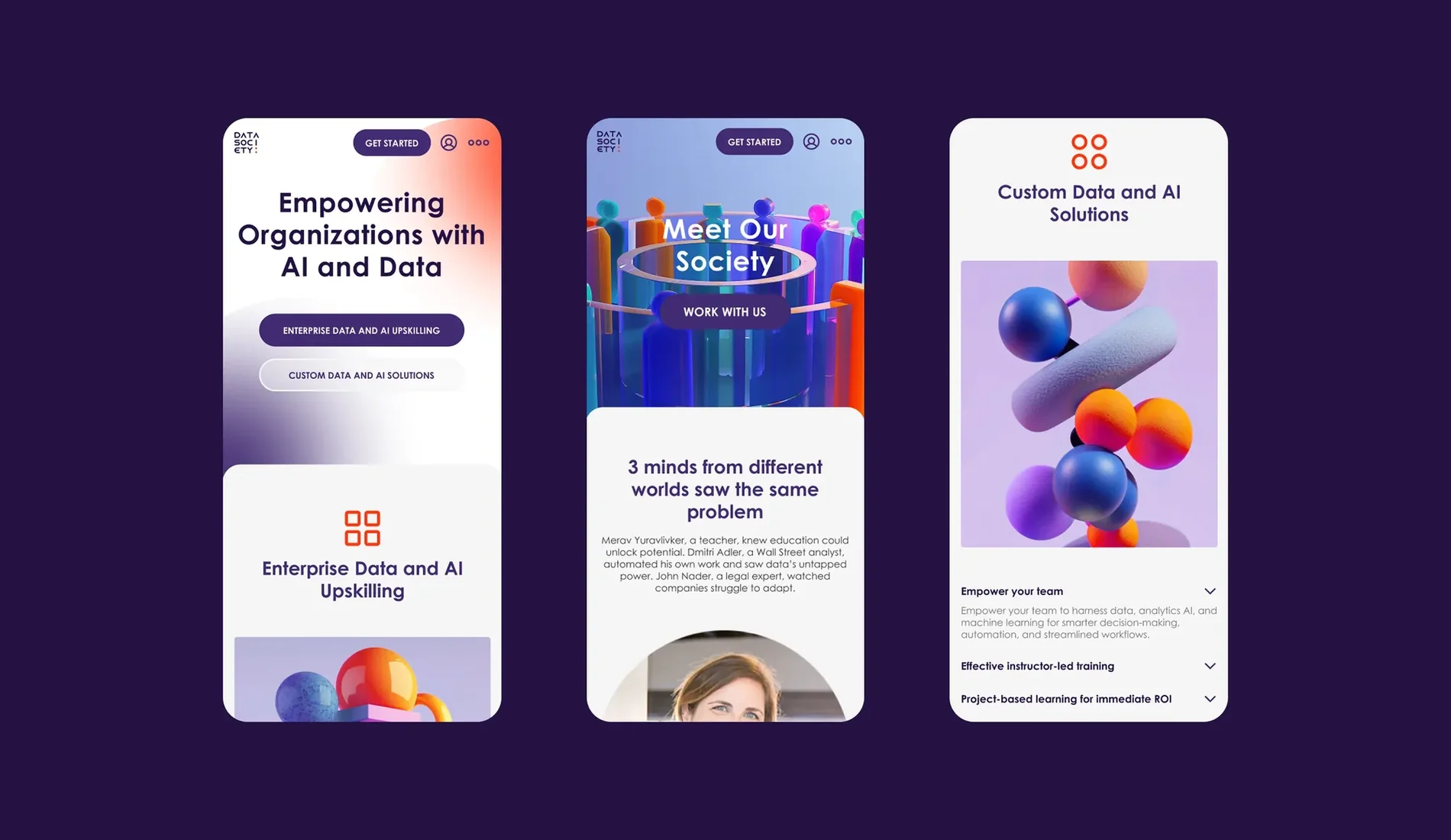
Data Society: the structure was rebuilt around two offers, so a visitor reaches the right one in a click or two.
3. Who will actually do the work?
Ask who handles strategy, design, development, content and project management, and whether the people in the pitch stay on the project. If work goes to contractors or another studio, find out where the handoffs are and who is accountable for quality.
Team size matters less than knowing who owns each decision.
4. When do UX, content and SEO come in?
If content arrives after the design is finished, the layout often does not fit the material. If SEO comes after development, structural choices are already expensive to change. Ask when the sitemap, page goals, headings and metadata are decided.
At Align, on-page SEO goes in during the build: structure, metadata, internal links and speed are decided while the pages are drawn. Google's SEO Starter Guide is a fair benchmark for what that should cover.

If content and SEO arrive after design, the layout is already fixed around the wrong material.
5. What will our team be able to edit?
Ask for a demo of the CMS on a page like yours. Can your team add a case study or a resource without breaking the layout? What training and documentation come with handover?
At Align, the editable regions are agreed at the wireframe stage, and handover includes a guide written for your team rather than for developers. Whoever you choose, settle this before launch, not after.
6. How do you handle integrations and technical constraints?
List the CRM, analytics, booking, search or other systems the site has to connect to. Ask who configures each one, what access is needed and how it is tested. For an existing site, ask how the agency will review current URLs, hosting, forms and tracking before it proposes a migration.
"We will integrate the CRM" is not enough. Ask what that covers: which forms, which routing rules, consent, event tracking.
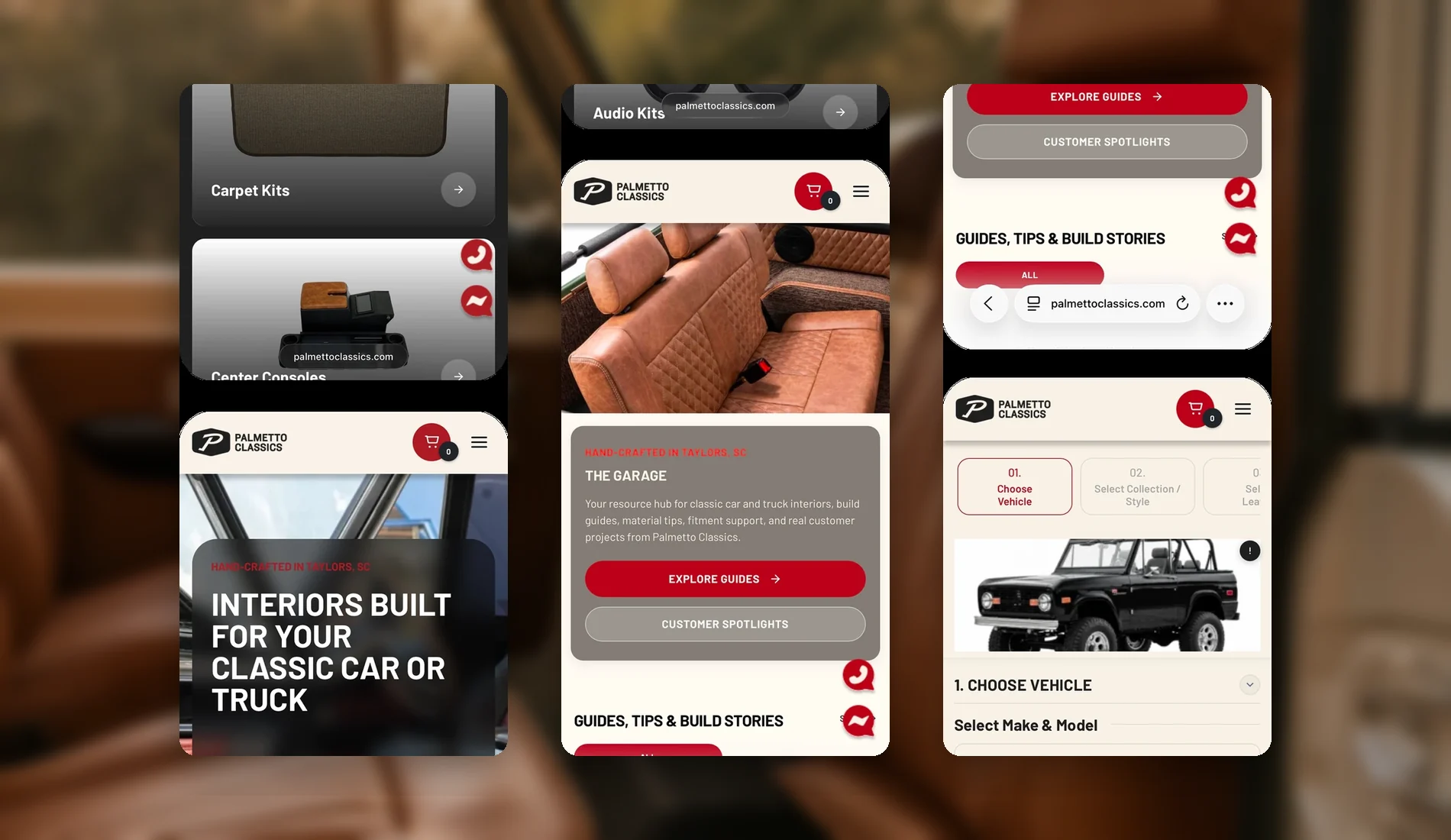
Palmetto Classics: the store connects to inventory, custom requests and production, not just a cart.
7. What do you test, and to what standard?
Ask which devices, browsers and user journeys are tested: mobile layouts, keyboard navigation, forms, search and page speed. Accessibility belongs in design and development, not in one automated scan at the end. WCAG 2.2 is the usual reference, and Core Web Vitals measured on a phone is the usual reference for speed.
Align tests every build on a mid-range Android over a normal connection, because that is closer to what most visitors use than an office laptop on fibre.
8. How are scope, feedback and timeline managed?
Ask for the stages, decision points, review windows and what your team has to deliver at each one. A real timeline shows dependencies: content approval before a template is final, IT access before an integration starts.
Ask what happens when a new requirement shows up halfway through. A clear change process estimates the effect on cost and timing before work starts, so you choose the trade-off instead of discovering an overrun at the end.
9. What proof can you share, and what happens after launch?
Read case studies for the problem, the agency's role, the decisions and the result. Look for work that matches your complexity, even in a different industry. Ask to speak to a client.
Then ask about handover. Who owns the source files, CMS, analytics and accounts? Is there a warranty period? Align supports every project for at least three months after launch at no extra cost, and the ETA Transit project shows the kind of site where that matters: a complex product line that ETA's own team has to keep updating as it grows.
Compare Agencies With a Scorecard
Fill this in after each conversation. Weight the rows for your project: a migration puts more weight on technical SEO, a new category launch on positioning and content.
| Area | What a good answer looks like | Score (1 to 5) |
|---|---|---|
| Business understanding | The agency can restate your problem and the outcome | |
| B2B experience | Work for complex sales or several decision-makers | |
| UX and content | A clear method for navigation, page goals and messaging | |
| SEO and technical work | A concrete plan for structure, metadata, redirects and QA | |
| CMS and ownership | Your team can maintain the site; access is clear | |
| Project management | Milestones, decisions and risks are written down | |
| Communication | Direct, responsive, easy to work with | |
| Cost and scope | Inclusions, assumptions and exclusions are stated | |
| After launch | Handover, warranty and support are documented |
The scorecard does not replace judgment. It shows you why you chose a partner and exposes gaps a good presentation can hide.
Warning Signs
- A promise of a specific Google ranking.
- A fixed timeline before anyone has seen your content or integrations.
- No clear answer on who will do the work.
- Accessibility and redirects treated as optional extras.
- A quote that lists deliverables but no assumptions or client responsibilities.
- A process where one person approves everything at the end.
When Align Is Not the Right Fit
If you need a large in-house team on site every week, a big network agency will suit you better. If you only need a template theme installed quickly, a freelancer is cheaper. Align fits B2B companies that want strategy, design, a hand-coded build and SEO from one team, with website projects from $2,000 to $8,000 and up.
Frequently Asked Questions
How many agencies should we talk to?
Three is usually enough. Fewer gives you nothing to compare, and more turns the process into a second job. Send all three the same brief.
Should we choose the cheapest proposal?
Only if it covers the same scope. A low quote often leaves out content migration, redirects, testing or support. Compare what each proposal delivers before you compare the totals.
Does the agency need experience in our industry?
It helps less than you think. Experience with your kind of problem matters more: a complex offer, several buyers, a migration with traffic at stake.
How long does a B2B website project take?
At Align, a marketing site of ten to twenty pages usually takes ten to fourteen weeks. The design phase moves most, depending on how fast content and feedback come back.
Talking to Agencies Now?
Put Align on your list. Read how our website design service runs, see what a website redesign usually costs, or send us your brief and ask us the nine questions above. We will answer them for your project, in writing.
References
- Google Search Central: SEO Starter Guide
- W3C: Web Content Accessibility Guidelines (WCAG) 2.2
- web.dev: Web Vitals


