
Why do you need a website when your business already has social media, referrals, ads, or a Google Business Profile? It is a fair question. After all, many businesses are already visible in different places online. You might have an Instagram page, a LinkedIn profile, a few directory listings, a Google Business Profile, and a steady stream of referrals from people who already know you. On paper, that may sound like enough. In reality, it often creates a scattered digital presence where people can find pieces of your business, but not the full story.
A website gives your business a central place to bring everything together. It is where people can understand who you are, what you offer, why you are credible, and what they should do next. More importantly, a strong website strategy turns your website from a simple online brochure into a business tool that supports marketing, sales, SEO, customer experience, hiring, and long-term growth.
For modern businesses, the better question is not only “why do you need a website?” The better question is: what should your website be doing for your business? A good website helps people understand you faster. A great website helps the right people trust you sooner.
The Short Answer: Why Do You Need a Website?
You need a website because your business needs a trusted digital home that you own and control. Social media can help people discover you, but your website helps people understand you. It gives you space to explain your services, show proof, answer questions, build credibility, and guide visitors toward a clear next step.
A strong business website can help you build trust, improve search visibility, support marketing campaigns, convert visitors into leads, and create a more consistent brand experience. It also gives you more control over your message. You are not trying to explain your entire business inside an Instagram bio, which, let’s be honest, was never built to carry that much responsibility.
Your website is not just a place where people “check you out.” It is often the place where they decide whether your business feels professional, relevant, and worth contacting.

A Website Is No Longer Just an Online Brochure
For years, many businesses treated websites like digital brochures. Add a homepage, an about page, a few services, a contact form, and done. Technically, that is a website. Strategically, it may not be doing very much.
Today, users expect more. They compare businesses quickly. They scan your homepage, look for proof, read a few lines of copy, check whether the design feels current, and decide whether to stay or leave. That entire judgment can happen in seconds. No pressure.
This does not mean your website needs to be complicated or filled with flashy animations. In fact, many effective websites are simple. But they are simple with intention. The structure is clear. The message is focused. The visuals support the content. The calls to action are easy to find. The user journey feels natural.
That is the difference between having a website and having a website strategy.
| A Basic Website | A Strategic Website |
|---|---|
| Lists information | Guides users toward action |
| Focuses mostly on appearance | Connects design with business goals |
| Uses generic service pages | Explains value clearly for each audience |
| Makes visitors figure things out | Creates a clear user journey |
| May not support SEO | Built with search visibility in mind |
| Gets updated only when something breaks | Improves over time based on performance |
A website strategy helps make sure every section, headline, visual, CTA, and page has a reason to exist. Nothing is there just because “websites usually have that section.” Every piece should help the visitor move closer to understanding, trusting, or contacting your business.
Your Website Builds Trust Before Anyone Talks to You
Before someone sends an inquiry, books a call, visits your office, or asks for a quote, they usually want reassurance. They want to know if your business is real, if you understand their problem, if your work looks professional, and if other people have trusted you before.
Your website helps answer those questions before your team ever enters the conversation.
Trust is built through small details. A clear headline builds trust. A professional visual system builds trust. Real testimonials build trust. Strong service pages build trust. A fast, mobile-friendly experience builds trust. Even the way your contact form is written can make someone feel either comfortable or slightly suspicious.
Nielsen Norman Group also highlights trustworthiness as an important factor in how users evaluate websites, especially when they are deciding whether a business feels credible enough to engage with [3]. A weak website creates hesitation. A thoughtful website reduces it.
A website does not create trust with one big statement. It creates trust through every small detail that makes a visitor feel informed, respected, and confident.
This matters because most people do not wake up excited to fill out a contact form. They need a reason. They need confidence. They need to feel like reaching out will be worth their time. A good website helps them get there.
Your Website Gives Your Brand One Clear Digital Home
Social media platforms are useful, but they are not a replacement for a website. They are rented spaces. Algorithms change. Formats change. Reach changes. The platform that performs well today may not perform the same way next year.
A website gives your brand a digital home that you own. It is the place where all your important information can live together in a clear, organized way. Your social media, email campaigns, ads, business cards, sales proposals, directory profiles, and even word-of-mouth referrals can all point back to one place that explains your business properly.
Without a website, your brand can start to feel scattered. A potential customer may see one version of you on LinkedIn, another version on Instagram, and a slightly outdated version in a directory listing from 2019 that nobody remembers creating. A website helps bring the story back under your control.
For growing businesses, this is especially important. As your services expand, your audience changes, or your team grows, your website becomes the place where your brand stays consistent.
A Website Helps People Understand What You Actually Do
One of the biggest website problems is not bad design. It is unclear communication. Many businesses understand their own work so well that they forget what it feels like to encounter it for the first time. Their website may describe services using internal language, industry jargon, or vague phrases that sound polished but do not actually say much. Words like “innovative solutions” and “end-to-end excellence” may sound nice, but users are usually looking for something more direct.
They want to know what you do, who you help, what problem you solve, what makes you different, and how to get started.
A good website strategy turns that information into a clear journey. It does not dump everything on the visitor at once. It guides them. The homepage gives the big picture. Service pages explain the details. Case studies show proof. Blog posts answer deeper questions. CTAs make the next step obvious.
This is where UX/UI design, content strategy, and brand messaging need to work together. The words matter. The layout matters. The order of information matters. Your website should not simply contain information. It should make information easier to understand.
A Website Supports SEO and Long-Term Visibility
If people are searching for your services online, your website is one of your most important SEO assets.
Search engines need content, structure, context, and technical clarity to understand what your business offers. A strong website gives you the foundation to create service pages, publish helpful blog content, build internal links, and target the search terms your audience actually uses.
This is another reason the question “why do you need a website” matters. Without a website, your business has limited control over how it appears in search. With a strategic website, you can build pages around your services, locations, industries, FAQs, resources, and expertise.
For example, a service business may need more than one general services page. It may need detailed pages for each core service, supporting articles that answer common questions, case studies that prove experience, and internal links that help users move naturally through the site.
Google’s guidance on helpful content encourages businesses to create reliable, people-first content. That means your website should not be built only for keywords. It should genuinely help users understand a topic, compare options, and make better decisions [1].
SEO is not magic. It is not a secret button hidden in the WordPress dashboard. It works best when your website has clear content, strong structure, technical health, and a reason for people to stay.

Your Website Makes Every Marketing Channel Work Harder
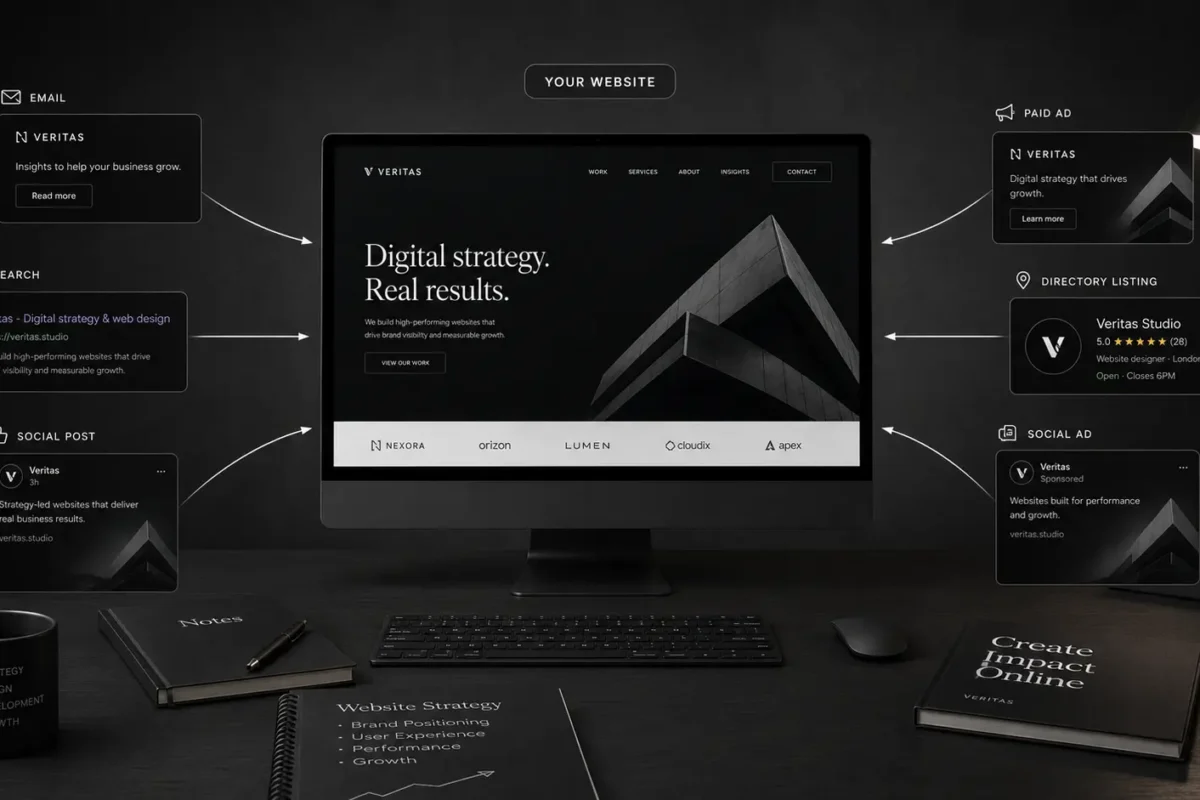
Most marketing channels eventually lead people back to your website. Someone may discover you through LinkedIn, Instagram, a paid ad, Google Search, a referral, an email campaign, a podcast, a directory listing, or an event. But when they want to understand your business more seriously, they usually look for your website.
If the website experience is weak, your marketing becomes less efficient. You might spend money on ads that send people to a confusing page. You might post great social content that leads to a site that feels outdated. You might get strong referrals, but lose people because the website does not reflect the quality of your actual work.
A better website strategy helps every channel feel more connected. Your ads can point to relevant landing pages. Your blog posts can support SEO. Your social media can drive people toward deeper resources. Your service pages can explain what you do in a way that sales conversations can build on. In other words, your website is not separate from your marketing. It is the place where your marketing often becomes measurable.
A Website Helps Convert Interest Into Action
A visitor does not become a lead just because your website looks nice. A beautiful website may get attention, but clarity is what helps people take action.
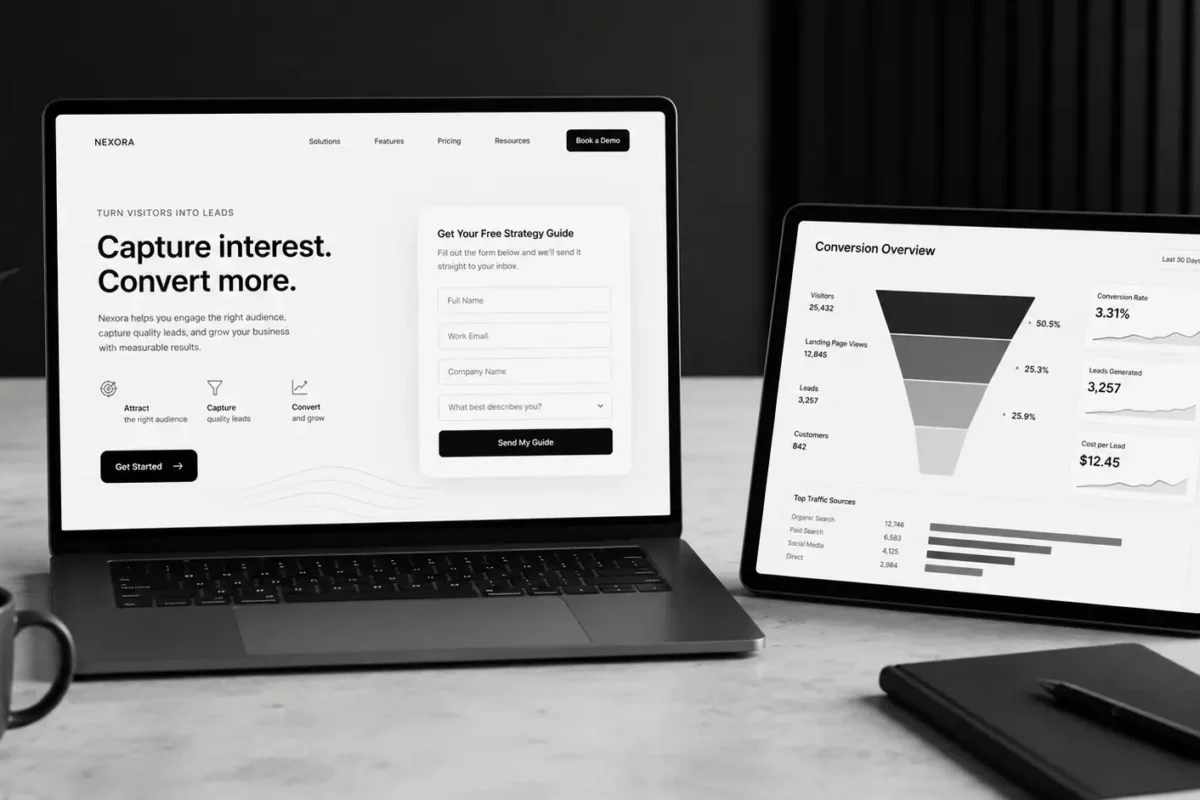
Conversion-focused website strategy looks at the full experience. Does the visitor understand the offer? Is the CTA clear? Does the page answer common objections? Is there enough proof? Does the design guide the eye? Does the form feel simple? Does the mobile experience work smoothly? Does the page make the next step feel easy?
Conversion does not always mean an immediate purchase. For many businesses, it means booking a call, requesting a quote, sending an inquiry, downloading a guide, joining a newsletter, or exploring a service page. The goal is to create momentum.
A good website does not pressure users. It helps them feel ready.
That is the balance businesses should aim for. Your website should be persuasive, but not pushy. Clear, but not boring. Helpful, but not so overloaded with information that reading it feels like homework with a contact form at the end.
A Website Helps Smaller Businesses Compete With Bigger Brands
A strong website can make a smaller business feel more established, credible, and organized. That does not mean pretending to be bigger than you are. It means presenting your work with clarity and confidence.
You may not have the largest team, the biggest office, or the longest history. But if your website clearly explains your value, shows strong proof, and creates a smooth user experience, you can compete more effectively.
This is especially true for service businesses, consultants, creative teams, clinics, nonprofits, and B2B companies. People are not only comparing price. They are comparing confidence. They want to know who seems organized, thoughtful, experienced, and easy to work with.
Your website can show your process, your expertise, your results, your values, your past work, and your point of view. When all of that comes together well, your business becomes easier to choose.
A Website Gives Your Business Room to Grow
Your business will change over time. Services evolve. Teams grow. Markets shift. Customers ask better questions. Competitors improve. What worked three years ago may no longer support where you are going.
A strong website strategy gives your business room to grow. Instead of rebuilding everything every time you launch a new offer or target a new audience, you can build a flexible foundation from the start.
A growth-ready website can support new service pages, case studies, blog content, landing pages, SEO topic clusters, new industries, new locations, new integrations, and future automation. This is one reason planning matters so much. A website should not only serve your business today. It should make the next stage easier.
A website with no strategy can become messy very quickly. One new page here, one random landing page there, three outdated blog posts, five CTAs written in different tones, and suddenly the site feels like a digital junk drawer. Everyone has one. Nobody wants to show it to guests.
What Happens When You Have a Website but No Strategy?
Some businesses technically have a website, but the site is not doing enough. It exists, but it does not support the business in a meaningful way.
This often happens when the homepage does not clearly explain the business, service pages are too thin, the design feels outdated, the CTA is hard to find, or the content does not support SEO. Sometimes the website looks fine visually, but the message is too vague. Other times, the content is useful but buried under a layout that makes people work too hard.
The real issue is friction. Every unclear section, slow page, broken link, confusing menu, or missing proof point adds friction. And when visitors feel friction, they leave, delay, or choose someone else.
A website strategy helps remove that friction. It gives the site a job, a structure, and a clearer path for users to follow.
What Should a Modern Website Strategy Include?
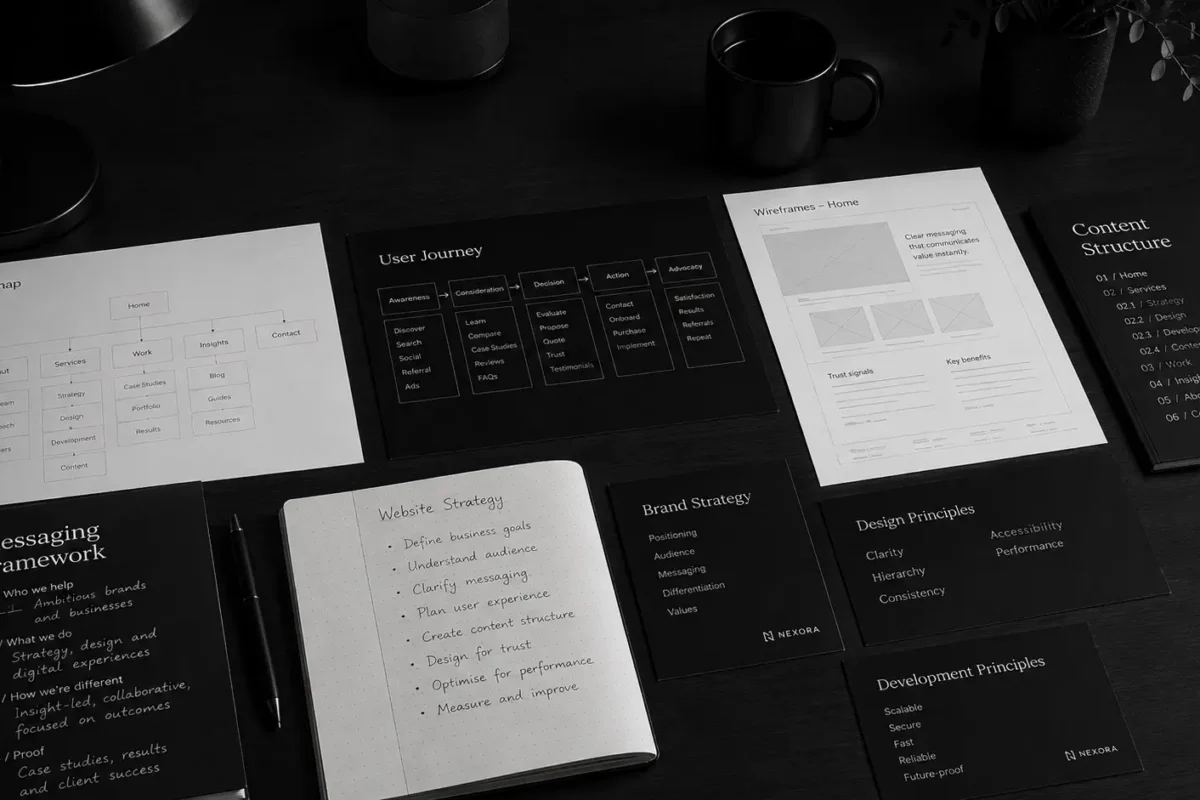
A better website strategy is not just a design plan. It brings together business goals, audience needs, content, UX/UI design, SEO, performance, and measurement.
Before designing anything, you need to know what the website should accomplish. A website for lead generation needs a different structure from an e-commerce website. A nonprofit website has different storytelling needs than a B2B consulting firm. A local healthcare website needs different trust signals than a creative agency.
Once the goal is clear, the audience becomes the next priority. Who is using the site? What do they care about? What are they worried about? What information do they need before taking action? Good websites are not built around what the business wants to say first. They are built around what the user needs to understand.
From there, messaging and information architecture shape the experience. Your website needs strong headlines, clear service explanations, useful page structure, and a navigation system that makes sense. UX/UI design then turns that strategy into an experience people can actually use. SEO ensures the site can be understood by search engines. Performance and technical quality make the experience feel smooth.
Core Web Vitals are one way Google describes real-world user experience around loading performance, interactivity, and visual stability [2]. Web performance also affects how people experience a site in practical terms: if the page feels slow, unstable, or frustrating, users may leave before the content has a chance to do its job [4].
Here is a simple way to look at it:
| Website Strategy Element | What It Helps With |
| Business goals | Defines what the website needs to achieve |
| Audience understanding | Makes the content more relevant and useful |
| Messaging | Helps visitors understand your value quickly |
| Information architecture | Organizes pages and navigation clearly |
| UX/UI design | Turns the strategy into a usable experience |
| SEO foundation | Supports search visibility and content growth |
| Performance | Improves speed, stability, and user experience |
| Measurement | Helps the website improve after launch |
When these pieces work together, the website feels intentional. Visitors may not notice every strategic decision, but they will feel the difference.
A Simple Website Strategy Checklist
If you want to evaluate your current website, start with a few honest questions.
Can a visitor understand what you do within a few seconds? Does your homepage explain who you help and why your work matters? Are your service pages detailed enough to build trust? Is your CTA easy to find? Does your website show testimonials, case studies, client logos, or other proof? Does the site work well on mobile? Is the content structured for SEO? Does the website still reflect where your business is today?
If several of those answers are “not really,” your website may not need a tiny content update. It may need a stronger strategy.
That does not always mean a full redesign. Sometimes the right move is improving the homepage, expanding service pages, cleaning up navigation, adding better proof, or strengthening SEO content. The key is knowing what problem you are solving before jumping into design changes.
Do You Need a Website If You Already Have Social Media?
Yes. Social media is valuable, but it should not carry your entire digital presence.
Social media is great for visibility, personality, updates, and community. But it is not always great for structured information. It is hard to explain a full service offering inside a feed. It is harder to organize proof, process, FAQs, case studies, and conversion paths. And because social platforms are built around constant movement, even your best content can disappear quickly.
A website gives your business a place where important information stays easy to find. It also gives you more control over how people experience your brand. Social media can create attention. Your website can turn that attention into trust.
Do You Need a Website If Most Leads Come From Referrals?
Yes, because referred customers still research you. A referral may open the door, but your website often helps people decide whether to walk through it. If someone hears about your business from a friend or colleague, they may still visit your website before contacting you. They want to confirm that your business feels like the right fit.
A strong website makes referrals easier to convert. It gives people a place to validate what they heard, understand your services, review your work, and feel more comfortable reaching out. In that sense, your website does not replace word of mouth. It supports it.
How Website Strategy Supports SEO
A better website strategy gives SEO a stronger foundation. Instead of publishing random content and hoping something works, you can build a structure around your most important services and topics. A website design agency, for example, may have a main website process page, supporting blog articles, case studies, FAQs, and internal links that connect those pages together.
This helps users and search engines understand the relationship between your content. Someone may arrive through a broad blog post like this one, asking “why do you need a website,” and then naturally move toward a more service-focused page like Align’s Website Process, where the strategy, UX/UI design, development, SEO, and launch support work together. That journey matters. Good internal linking is not just an SEO tactic. It is a better user experience. It helps people move from curiosity to clarity.
When Does Your Website Need Improvement?
Your website may need improvement if your business has grown but your site still feels stuck in the past. Maybe your services have changed, but the navigation has not. Maybe your team has better work now, but the portfolio still shows old projects. Maybe your site gets traffic, but not enough inquiries. Maybe you avoid sending people to it, which is usually a sign that the website is quietly embarrassing everyone in the room.
Other signs are more technical. The site may load slowly, perform poorly on mobile, struggle with indexing, or fail to support your SEO goals. Sometimes the issue is content-related. Your pages may be too short, too vague, or not aligned with what people are actually searching for.
The goal is not to redesign for the sake of redesigning. The goal is to make sure your website supports the business you are becoming.
What a Strong Website Process Looks Like
A strong website does not happen by accident. It usually comes from a clear process that connects strategy, content, design, development, SEO, testing, and launch support.
At Align, a thoughtful website process starts with understanding the business, audience, goals, timeline, and success metrics. From there, the sitemap and UX planning help organize the site around the user journey. Wireframes shape the content flow before the design becomes too detailed. Custom UX/UI design brings the brand and experience to life. Development turns the design into a responsive website that works across devices. SEO setup prepares the site for visibility. Quality assurance helps catch issues before launch. Handover gives the team confidence to manage the site after it goes live.
This kind of process matters because a website is not one thing. It is a system. When each part is planned well, the final experience feels smoother, clearer, and more useful.
If your business is planning a new website or redesign, you can explore Align’s full Website Process to see how strategy, UX/UI design, development, and SEO can work together.
Common Website Strategy Mistakes to Avoid
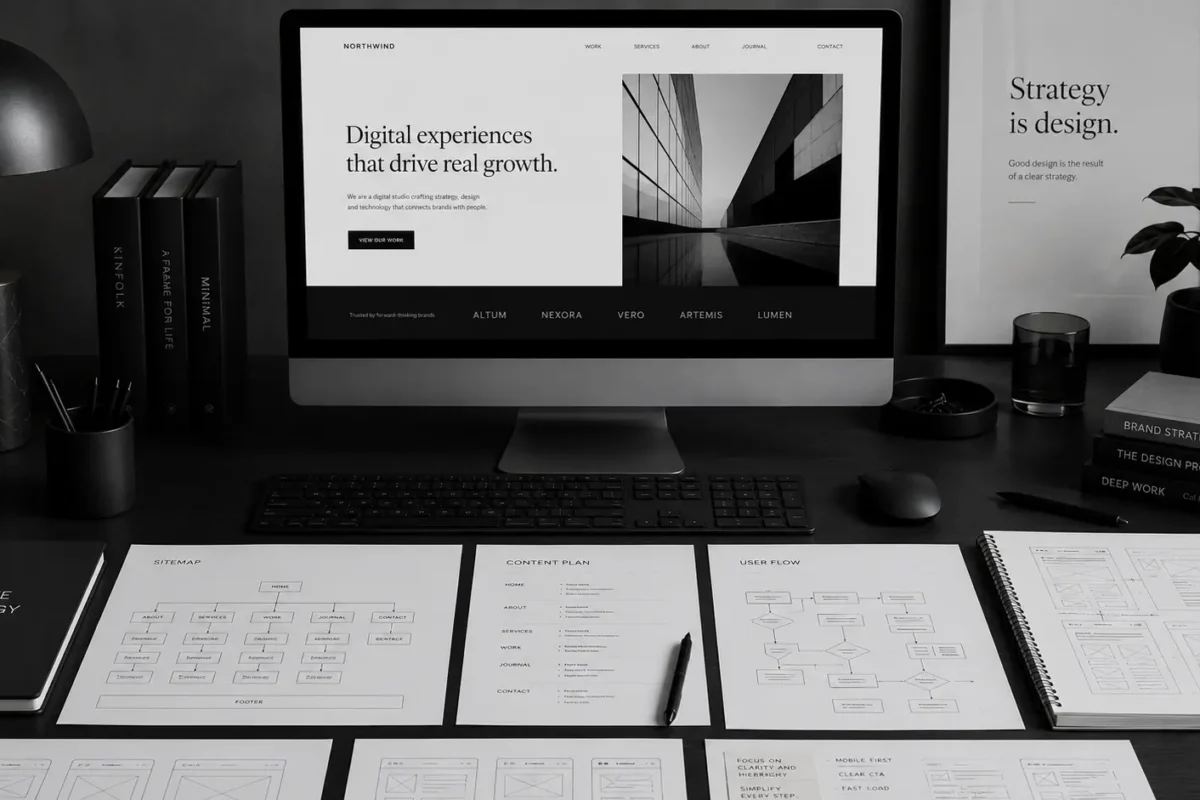
One common mistake is starting with design before strategy. Visual direction is important, but if the goals, audience, message, and structure are unclear, the design may look beautiful while still failing to guide users.
Another mistake is writing service pages that are too thin. A short service page may feel clean, but it may not give people enough information to trust you. It can also limit SEO performance because search engines and users need context.
Many websites also hide the CTA. If visitors have to search for how to contact you, the page is working too hard against itself. A clear CTA should appear naturally throughout the experience, especially after sections that build trust or explain value.
Finally, many businesses treat launch as the finish line. In reality, launch is the beginning of the website’s life. The best websites continue to improve based on content needs, SEO data, user behavior, and business growth.
So, Why Do You Need a Website?
You need a website because your business needs a place where attention becomes understanding, and understanding becomes trust.
A modern website gives your business a foundation for visibility, credibility, marketing, sales, SEO, content, and long-term growth. But the website itself is only part of the answer. The strategy behind it is what makes it work.
A strong website strategy helps you communicate clearly, serve users better, and guide the right people toward action. It makes your brand easier to understand, easier to trust, and easier to choose.
So if you are asking “why do you need a website,” the answer is not just because your competitors have one. It is because your customers are already looking for reasons to trust you, and your website is one of the best places to give them those reasons.
Ready to Build a Website That Works Harder for Your Business?
Your website should be more than a digital placeholder. It should help people understand your business, trust your brand, and take the next step with confidence.
At Align, we create websites that connect strategy, UX/UI design, development, SEO, and long-term support. Whether you are launching a new site or improving an outdated one, we can help you build a clearer, stronger digital experience.
Explore our Website Process or Start a Project with Align.
References
- Google Search Central: Creating helpful, reliable, people-first content
- Google Search Central: Understanding Core Web Vitals and Google search results
- Nielsen Norman Group: 4 Trustworthiness Factors
- Web.dev: Web Vitals