You built a beautiful website, launched your product, and waited for the sales to roll in, but instead, you are met with high bounce rates and abandoned carts. Many founders assume their interface is intuitive simply because they designed it, yet they often fail to realize their small business in need of ux research is actually losing money through friction points they cannot see. UX research is not a luxury reserved for tech giants with massive budgets; it is a vital diagnostic tool that bridges the gap between what you think your customers want and how they actually behave online.
Ignoring the user experience can be a costly mistake, especially when you consider that every dollar invested in UX can yield a return of up to 100 dollars. By identifying exactly where users get stuck, you stop guessing and start making data driven decisions that impact your bottom line. If your conversion rates are stalling or your support inbox is overflowing with the same basic questions, it is time to stop polishing the surface and start investigating the root cause of your user friction.
What UX Research Actually Means for a Small Business
For a small business, UX research is often misunderstood as an academic exercise or a luxury for Silicon Valley. In reality, it is the most practical way to ensure your website or app is actually working for your customers. It involves a systematic approach to understanding the needs, behaviors, and pain points of your specific audience. Instead of following generic design trends, you are looking at how real people interact with your unique digital storefront.
UX research is not just about making things look pretty; it is the process of uncovering the mental models your customers use to navigate your world.
This process typically combines qualitative and quantitative methods. For a small team, this might look like observing a customer try to complete a purchase, or analyzing heatmaps to see where users are clicking fruitlessly. By grounding your design decisions in evidence rather than internal opinions, you eliminate the guesswork that often leads to expensive redesigns later on. According to research by the Nielsen Norman Group[1], even small-scale testing with just five users can reveal the majority of your site’s usability issues, making it a highly efficient strategy for growing brands.
The Small Business Research Cycle:
- Observe how real users navigate your current interface without intervention.
- Identify the specific friction points where users drop off or get confused.
- Hypothesize and implement targeted design changes based on those findings.
- Validate the new solution to ensure it actually solves the original problem.
Ultimately, your small business in need of ux research is looking for clarity. It is about moving from “I think this works” to “I know this works because I have seen our customers do it.” This shift in mindset transforms your website from a static brochure into a high-performing tool that actively supports your business goals.
5 Signs Your Small Business Is in Need of UX Research Right Now
Not every business needs a full research sprint at any given moment. But if you recognize any of the following, UX research should be your next move.
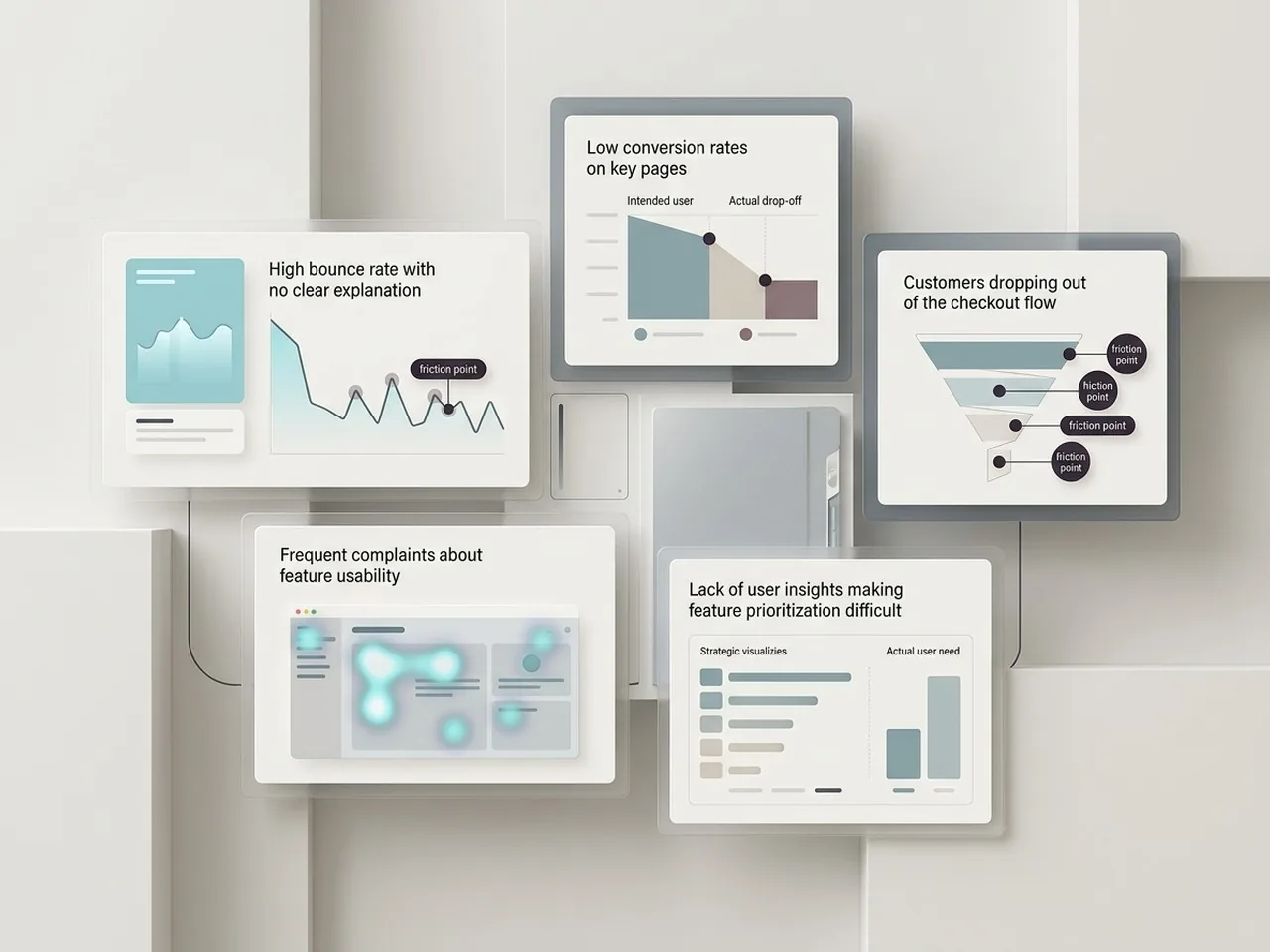
1. High bounce rate with no clear explanation
If a significant portion of visitors land on your site and leave without interacting, your analytics will show you the number but not the reason. Is the page slow? Is the headline unclear? Does the layout feel untrustworthy? Only talking to real users (or watching them navigate in real time) will surface the actual cause.
2. Customers ask questions your website already answers
When your support inbox fills up with questions like “Do you ship internationally?” or “What is included in your pricing?” and the answers are already on your website that is a navigation and information architecture problem. Users cannot find what they are looking for. That is a research problem before it is a design problem.
3. Drop-off at a specific step in your funnel
Cart abandonment, form drop-off, or exits at a specific onboarding step all point to friction at a particular moment. The global average cart abandonment rate sits at 70.19% Baymard Institute[2], but understanding why your users leave at step three of your checkout requires qualitative investigation, not just conversion data.
4. Conflicting feedback that is hard to act on
“The site is confusing” from one customer and “I cannot find the pricing” from another are not contradictory they are pointing at the same underlying issue from different angles. UX research gives you a framework to synthesize disparate signals into a coherent picture.
5. You are about to redesign or launch something new
A redesign without research is a common and costly mistake. If you are planning a significant change to your product or website, running discovery research first ensures you are solving the right problem rather than simply refreshing the surface.
Why Most Small Businesses Skip UX Research And Pay for It Later
It is common for founders to view user research as a corporate luxury reserved for companies with massive innovation labs. Usually, a small business in need of ux research avoids the process due to three specific friction points: limited budgets, tight timelines, and the natural overconfidence that comes from being close to the product. While these concerns feel valid on the surface, they often mask a much larger financial risk that compounds over time.
UX research is not a luxury item on a roadmap. For a small business, it is one of the highest-leverage investments you can make before writing a single line of code or briefing a designer.
The belief that “I already know my customers” is perhaps the most dangerous trap for a growing brand. Founders are often too close to their own interface to see the friction points that a first-time visitor encounters immediately. This proximity creates blind spots that lead to building features nobody actually wants. Regarding budget and time, a focused usability study with just five participants can often be completed in less than two weeks using low-cost tools, providing clarity that prevents months of wasted development cycles.
The ROI of Validating Early:
- Budget: In-house research costs almost nothing in cash compared to the price of a failed redesign.
- Speed: Spending ten days on testing saves sixty days of fixing broken logic later.
- Objectivity: Testing replaces founder bias with hard evidence of how users actually behave.
When resources are scarce, every decision carries immense weight. Skipping the research phase does not actually save money; it simply defers the cost. Whether it manifests as high churn or a confusing checkout experience, the price of ignoring the user eventually comes due. For example, research from Baymard Institute highlights that even minor friction in the checkout flow can lead to significant abandonment rates, proving that small design oversights have massive revenue implications.[3]
UX Research Methods That Work for Small Business Budgets
Many founders assume that quality research requires a high-tech lab and a five-figure recruitment budget. In reality, the most impactful insights for a small business in need of ux research often come from lean, scrappy methodologies that prioritize speed over formality. You do not need a massive sample size to identify the friction points killing your conversion rates; you just need to watch a handful of real people interact with your interface.
The Lean Research Toolkit:
- Guerrilla Testing: Take a laptop to a local coffee shop and offer a drink in exchange for ten minutes of honest feedback on a specific flow.
- Remote Unmoderated Sessions: Use affordable tools to record users navigating your site while they think out loud, providing raw context on where they get stuck.
- Stakeholder Interviews: Talk to your customer support or sales team; they already possess a goldmine of data regarding recurring user frustrations.
- Tree Testing: Strip away the visual design to see if users can actually find information within your menu structure alone.
The goal is to move away from guesswork and toward evidence-based iterations. Nielsen Norman Group has long advocated for the idea that testing with just five users is often enough to uncover the vast majority of usability issues. For a small business, this means you can run a highly effective study in a single afternoon without breaking the bank.[4]
In the world of small business UX, a single hour of observation is worth more than fifty hours of internal debate.
By focusing on these high-impact, low-cost methods, you ensure that your design decisions are rooted in reality. This lean approach allows you to fix critical errors early, ensuring your limited development budget is spent on features that your customers actually value and understand.
How to Run UX Research as a Small Business (Step by Step)
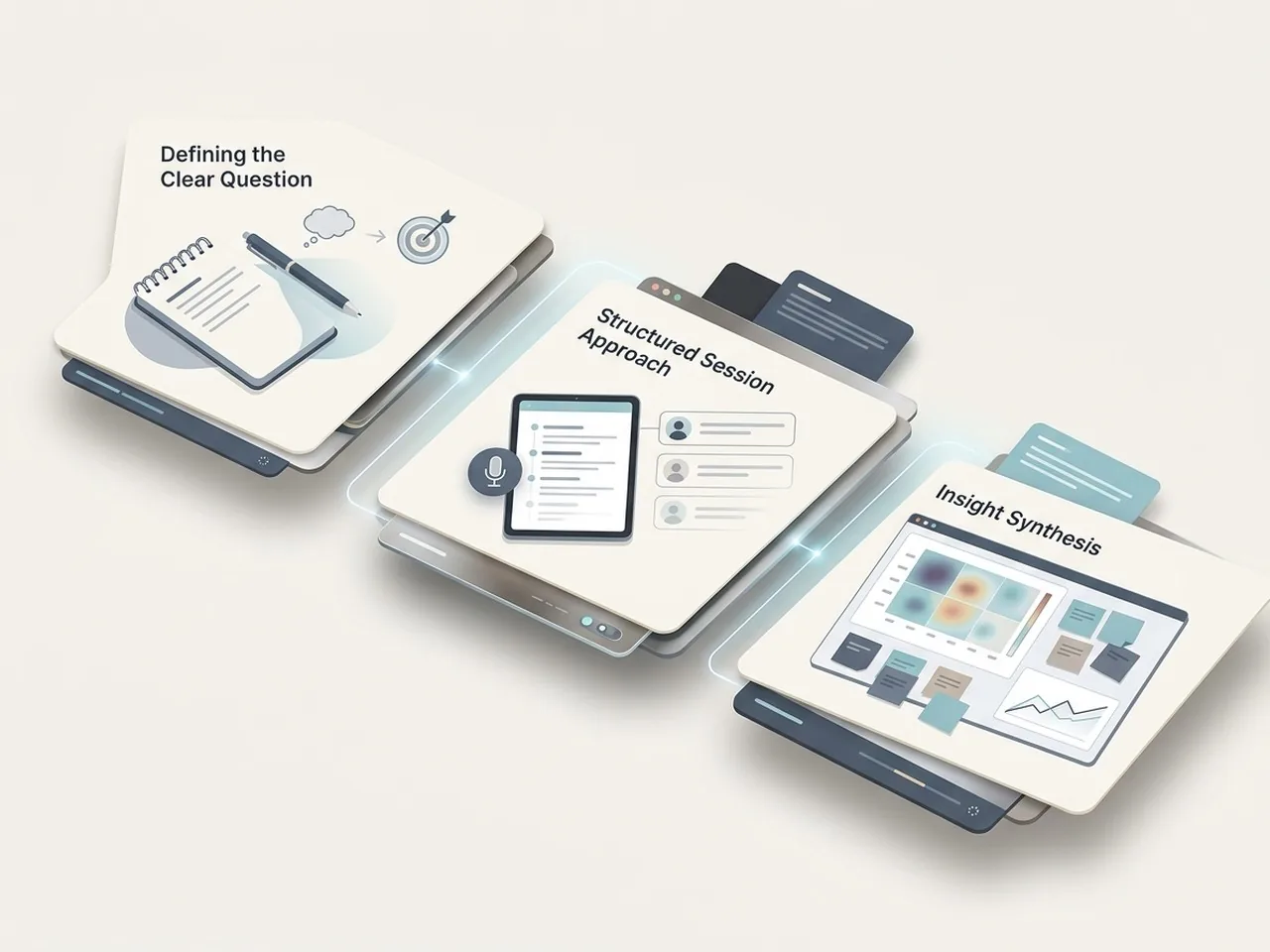
Running a successful session for a small business in need of ux research does not require a specialist title or a massive operations team; it simply requires a clear question, a structured approach, and a genuine willingness to listen. When resources are tight, focus on the high impact areas where user friction directly affects your bottom line.
1. Define Your Research Question
Start with what you actually need to know. Instead of asking a vague question like “what is wrong with the site,” try to pinpoint a specific friction point such as “why do users leave the pricing page without converting?” A specific question produces actionable answers that your team can implement immediately.
2. Choose Your Method and Recruit
Match the method to the question. Behavioral questions, such as where users click, call for heatmaps or session recordings. Motivational questions, like why a user did not complete a lead form, require direct interviews. For qualitative research, you need fewer participants than many assume. As the experts at the Nielsen Norman Group have famously demonstrated, testing with just five users can reveal the majority of your core usability issues.
The Lean Research Framework
- Focus on one specific user flow per study to avoid data fatigue.
- Recruit 5 to 8 participants from your existing customer list or social media.
- Record sessions to capture non-verbal cues and hesitations.
- Identify recurring themes rather than acting on outlier opinions.
3. Synthesize, Act, and Repeat
During your sessions, focus on observing rather than explaining your design. Once finished, group recurring themes and prioritize the issues that cause the most significant friction. Research is an iterative cycle; make your changes, then test again to confirm the fix actually worked. This loop is where the compounding value of UX research builds over time, turning a struggling interface into a high performing asset.
Should Your Small Business Hire for UX Research or Do It In-House?
Deciding whether to build an internal research muscle or outsource to an agency often comes down to the complexity of your product and the speed of your growth. For many small businesses, the DIY approach is a fantastic starting point. It builds deep empathy within your core team and ensures that everyone hears the user’s voice firsthand. However, as your product scales, the risk of internal bias increases; you might start seeing what you want to see rather than what is actually happening on the screen.
When to Keep It In-House
If you are in the early stages of product-market fit, internal research is invaluable. It is cost-effective and allows for rapid pivots. You do not need a dedicated Research Ops team to start; you simply need a structured approach and a willingness to listen without being defensive about your design choices. This hands-on experience often leads to more intuitive product decisions in the long run.
When to Partner with Specialists
Hiring a specialized agency like Align becomes necessary when the stakes are high, such as during a full brand pivot or a complex platform migration. Professional researchers bring a level of objectivity and methodology that is difficult to replicate internally. They can identify subtle friction points that a founder or lead designer might overlook due to their proximity to the project.
Design is only successful when it becomes invisible; when users move through your product without friction, without confusion, and without needing to ask for help.
The Decision Matrix: DIY vs. Agency
- In-House: Best for rapid prototyping, tight budgets, and building team empathy.
- Agency: Best for high-stakes launches, unbiased audits, and complex user journeys.
- Hybrid: Best for established businesses that need expert guidance to train their internal teams.
The Internal CTA
Whether you want to learn the ropes yourself or need a team of experts to uncover why your conversion rates are stalling, we are here to help. Explore our UX/UI design and SEO services to see how we can turn your user insights into a high-performing digital experience.
Every Small Business in Need of UX Research: Here is Where to Start
Running a research session does not require a specialist title or a massive operations team; it simply requires a clear question and a genuine willingness to listen. For a small business, the goal isn’t to produce a hundred-page report, but to uncover the specific friction points that prevent a visitor from becoming a customer. When you approach your website with curiosity rather than assumptions, you stop guessing what users want and start building what they actually need.
The Lean Research Framework
To get started, define a singular question, such as why users are dropping off at the checkout or what information is missing from your service page. Match your method to that question; use heatmaps for behavioral data and short interviews for motivational insights. You do not need a massive sample size to see patterns. As the foundational principles popularized by the Nielsen Norman Group[6] suggest, testing with just five users is often enough to reveal the vast majority of your usability issues.
The 3-Step Kickstart
- Recruit: Reach out to five existing customers or social media followers who fit your target profile.
- Observe: Watch them perform a specific task on your site without offering guidance or explanations.
- Iterate: Identify the two most frequent points of confusion and fix them before your next round of testing.
Design is only successful when it becomes invisible; when users move through your product without friction, confusion, or the need to ask for help.
Outro + CTA Draft
Running a UX research session does not require a specialist title or a massive research ops team. It simply requires a clear question, a structured approach, and a genuine willingness to listen to your customers. When you stop guessing and start observing, you remove the ego from the design process and replace it with data. By focusing on the specific behaviors and motivations of your users, even a small business can create a digital experience that feels intuitive and effortless. Remember that research is an iterative loop; each small fix compounds over time to build a product that users love and trust. Start small, stay curious, and let the insights guide your growth.
Align Helps Small Businesses Get UX Right from the Start
At Align, we work with small and mid-sized businesses to close the gap between what they have built and what their users actually need. Our website process integrates UX research directly into every stage of design and development from discovery through launch, so that decisions are grounded in real user behavior, not assumptions.
If you are about to redesign your website, launch a new product, or simply want to understand why your current site is not converting the way it should, we can help. See how we work
References
- Nielsen Norman Group: UX Research, Training, and Consulting – NN/G
- https://baymard.com/lists/cart-abandonment-rate
- 2024 E-Commerce Checkout: Expanded and Updated Checkout Research Findings – Baymard
- Usability and User Experience Research Reports by Nielsen Norman Group – NN/G
- NNgroup – YouTube
- Nielsen Norman Group – Wikipedia