
What are SEO topical maps, and why are more SEO teams talking about them?
In the past, many businesses approached SEO by choosing one keyword, writing one blog post, and hoping that page would rank. That method may have worked better years ago, but today, SEO is no longer just about publishing isolated articles around individual keywords.
Google has become much better at understanding the relationship between topics, pages, user intent, and website structure. A website that wants to grow organically needs more than random blog posts. It needs a clear content system that shows depth, relevance, and expertise around a specific subject.
This is where SEO topical maps become valuable.
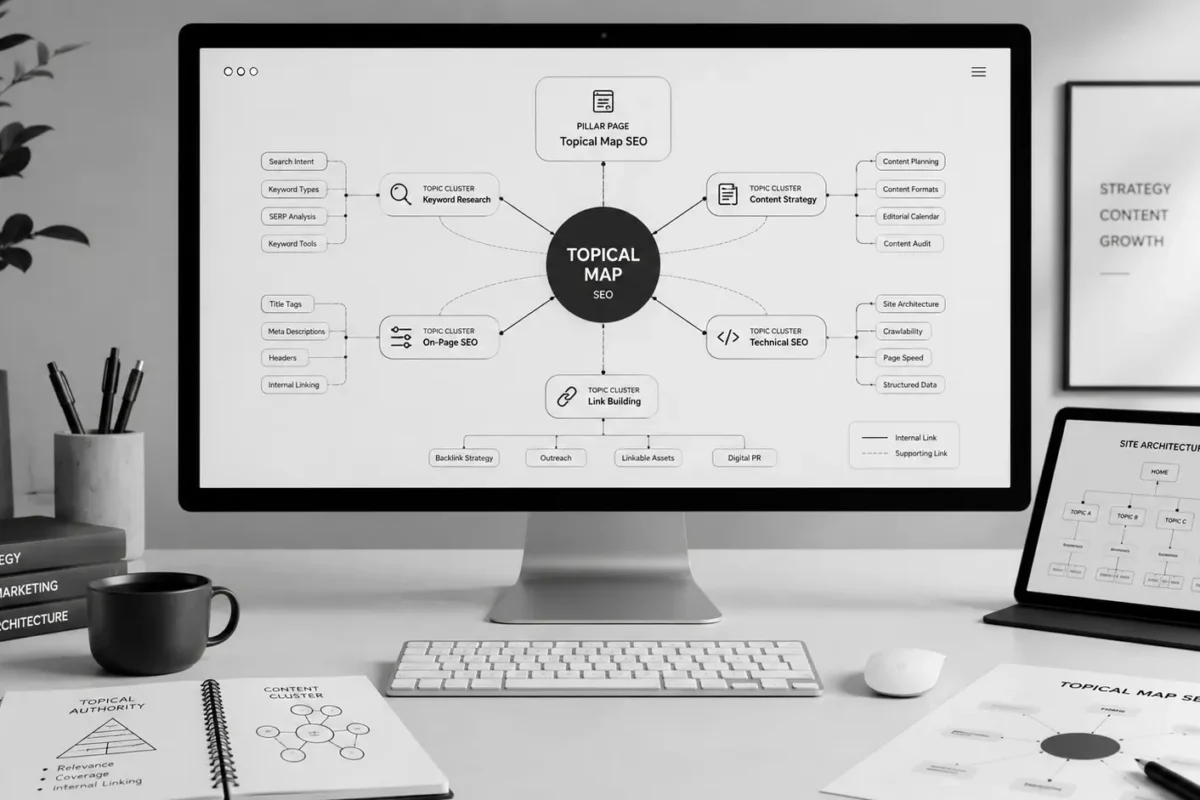
An SEO topical map helps businesses look at SEO as a structured content ecosystem instead of a long list of disconnected blog ideas. It shows which topics your website should cover, how those topics should be grouped, which pages should act as pillar content, which pages should support those pillars, and how all of these pages should connect through internal links.
When done well, an SEO topical map can help your content team write with more direction, build topical authority, improve internal linking, reduce duplicate content, and support long-term organic traffic growth.
What Are SEO Topical Maps?
SEO topical maps are structured content maps that organize a website’s SEO content around related topics and subtopics.
Instead of focusing only on individual keywords, an SEO topical map starts with a main subject, then breaks that subject down into subtopics, questions, search intents, and supporting content ideas. The goal is to help a website cover a topic with enough depth, breadth, and structure to be useful for both users and search engines.
For example, if an interior design company wants to build a topical map around “interior design,” the map may include topics such as:
- What is interior design?
- What are the steps in the interior design process?
- Popular interior design styles
- Interior design tips for small apartments
- Interior design for townhomes vs. apartments
- How to choose colors for interior design
- Common interior materials and how to choose them
- How to optimize living space
- How much does interior design cost?
- When should you hire an interior design company?
- Common mistakes when designing your own space
These articles should not exist as separate, disconnected posts. They should be connected through internal links and should guide readers toward important service pages, such as the company’s interior design service page or portfolio page.
In simple terms, SEO topical maps help a website answer the full range of questions around a subject instead of trying to rank for only a few separate keywords.
An SEO topical map is not just a keyword list. It is a strategic content map that helps a website build expertise, structure its content, and plan long-term SEO growth.
Why Are SEO Topical Maps Important?
SEO topical maps are important because Google does not evaluate every page in complete isolation. Search engines also look at the broader website, how pages relate to one another, how complete the information is, and how useful the experience is for people exploring the content.
According to Google Search Central [1], good SEO helps search engines crawl, index, and understand website content more effectively. Google also encourages websites to create helpful, reliable, people-first content. This means content should not be created just to insert keywords. It should genuinely answer user needs.
When a website has a clear topical map, a business can:
- Understand which articles should be written first.
- Identify which pages are pillar content and which are supporting content.
- Avoid publishing multiple articles that target the same intent.
- Create a more strategic internal linking structure.
- Cover more of the customer search journey.
- Build topical authority in a specific field.
- Help Google understand what the website is about.
- Create a long-term SEO foundation instead of publishing content randomly.
Without a topical map, content teams often write based on instinct. One week, they write about a keyword because it looks interesting. The next week, they copy a topic a competitor is ranking for. After a few months, the website may have many blog posts, but the content feels disconnected. There is no clear priority, no strong internal linking structure, and no content system that builds authority over time.
SEO Topical Maps vs. Traditional Keyword Research
Keyword research is still important. However, keyword research alone is not the same as a topical map.
If you only do keyword research, you may end up with a long spreadsheet of terms, search volume, difficulty, and intent. But that list does not automatically tell you how to organize the content, which article should be the main page, which articles should support it, or how everything should link together.
SEO topical maps turn keyword research into a strategic content structure.
| Criteria | Traditional Keyword Research | SEO Topical Maps |
|---|---|---|
| Main goal | Find keywords with volume, intent, and difficulty | Build a topic-based content structure |
| Perspective | Individual keywords | A full topic ecosystem |
| Output | Keyword list | Pillar pages, cluster pages, subtopics, and internal links |
| Risk | Content may become disconnected or repetitive | Content is more structured and less likely to overlap |
| SEO impact | Helps choose content topics | Helps build long-term topical authority |
| Best for | Keyword discovery stage | SEO content strategy stage |
For example, keyword research may give you terms like “SEO tips,” “technical SEO,” “internal linking,” “SEO audit,” and “SEO content strategy.” But an SEO topical map helps you decide:
- Do these keywords belong under the same main topic?
- Which page should be the pillar page?
- Which pages should be supporting cluster articles?
- Which articles should link to service pages?
- How should these pages connect to one another?
- Are there important questions missing from the search journey?
Keyword research gives you the raw material. An SEO topical map turns that raw material into a plan your team can actually execute.

Key Components of an SEO Topical Map
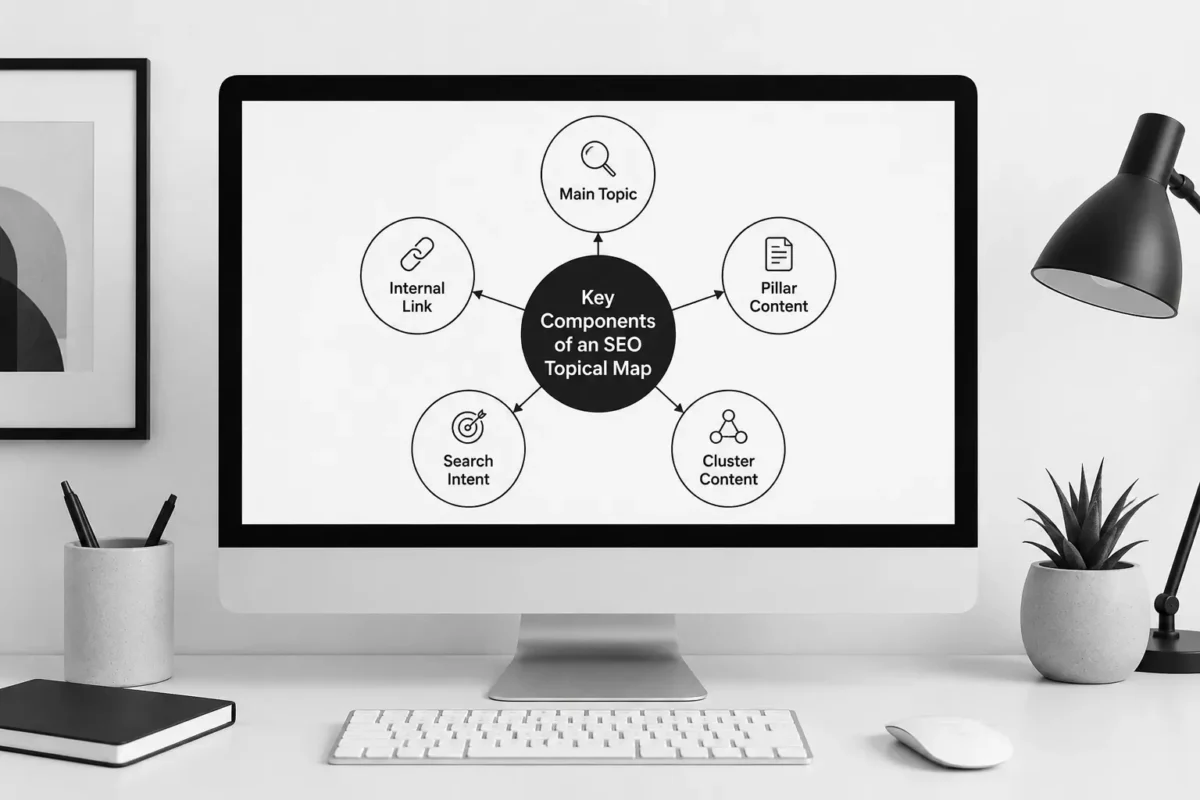
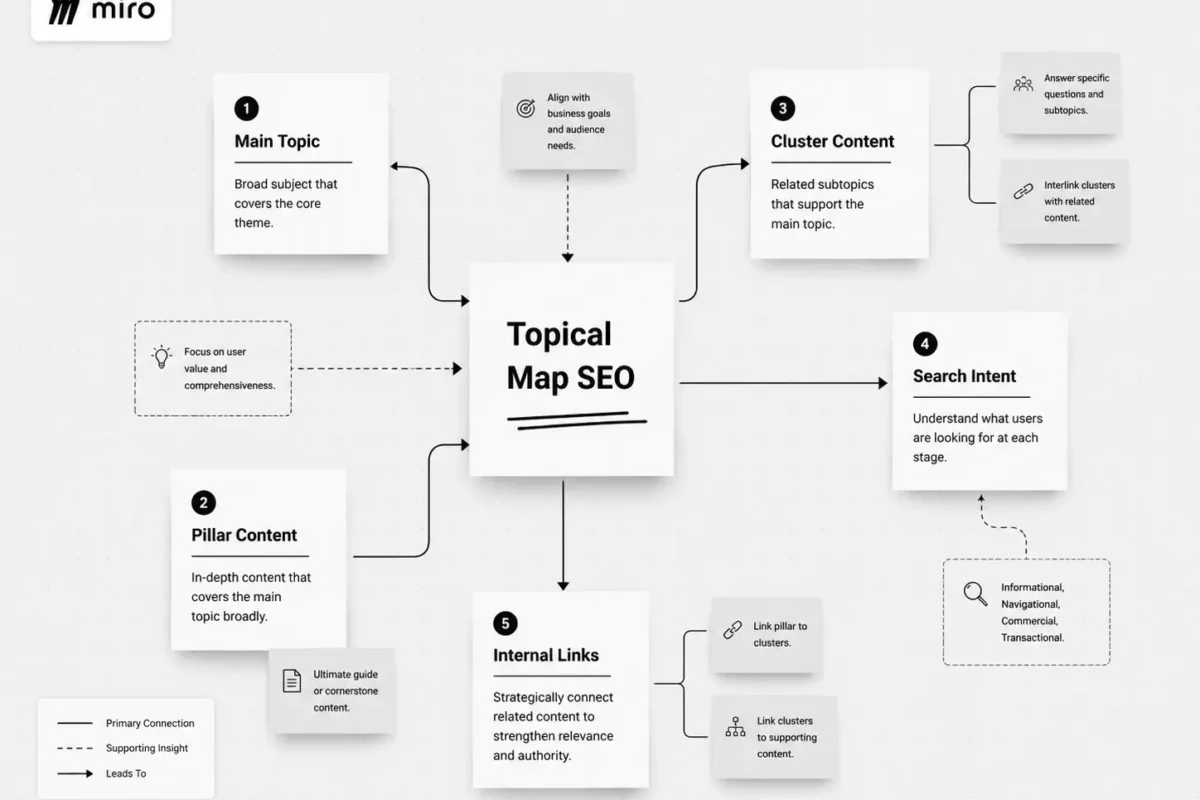
A strong SEO topical map usually includes several layers of content. Depending on the size of the website, the map can be simple or highly detailed. However, most topical maps should include the following components.
1. Main Topic
The main topic is the broad subject your website wants to build authority around.
For Align, possible main topics may include:
- SEO
- Website Design
- Branding
- Landing Page
- AI Automation
- Content Strategy
For this article, the main topic is SEO.
The main topic should be closely connected to your business, your services, and the questions your customers are already asking.
2. Pillar Content
Pillar content is the main article or page that broadly covers a larger subject. A pillar page usually explains the topic at a high level and links to more specific supporting articles.
For an SEO topic, pillar content could include:
- What is SEO?
- What is website SEO?
- What is an SEO process?
- A beginner’s guide to SEO for businesses
A pillar page does not need to answer every subtopic in extreme detail. Its role is to act as the central hub for a content cluster.
3. Cluster Content
Cluster content refers to smaller, more specific articles that go deeper into individual subtopics.
Examples may include:
- What are SEO topical maps?
- What is internal linking?
- What is technical SEO?
- What is an SEO audit?
- What is a meta description?
- Do Core Web Vitals affect SEO?
- How do you write SEO-friendly content?
These cluster articles should link back to the pillar content and connect to other related articles when relevant.
4. Search Intent
Search intent is the reason behind a user’s search. A good topical map should not only list keywords. It should also understand what the searcher wants.
Common types of search intent include:
- Informational: the user wants to learn something.
- Commercial: the user is comparing options.
- Transactional: the user is ready to buy, book, or contact.
- Navigational: the user is looking for a specific brand or page.
For example, the keyword “what are seo topical maps” has informational intent. A keyword like “SEO services for businesses” may have commercial or transactional intent.
Understanding intent helps your team decide whether a topic should become a blog post, a service page, a comparison article, a guide, or a landing page.
5. Internal Linking
Internal linking is one of the most important parts of an SEO topical map. If related pages do not link to one another, the topical map may look good visually but will not create as much SEO value in practice.
Google’s link best practices explain that links help Google discover other pages on a website, and anchor text helps both users and Google understand what the linked page is about [3].
When building an SEO topical map, businesses should define:
- Which articles should link to the pillar page?
- Which articles should link to a service page?
- Which related articles should link to one another?
- What anchor text would feel natural?
- Are any important pages missing internal links?
For Align, SEO blog articles should naturally link to the SEO Process page so readers can understand how Align approaches SEO as a structured, strategic process.
Example of an SEO Topical Map for an Agency Website
To make this easier to understand, below is a simple example of an SEO topical map for an agency that offers SEO, website, and branding services.
| Main Topic | Pillar Content | Cluster Content | Recommended Internal Link |
| SEO | What is SEO? | What are SEO topical maps? | SEO Process |
| SEO | What is an SEO process? | SEO audit checklist | SEO Process |
| SEO | SEO Content Strategy | How to write SEO-friendly content | SEO Process |
| Technical SEO | What is technical SEO? | Do Core Web Vitals affect SEO? | SEO Process / Website Process |
| Website SEO | What is an SEO-friendly website? | What does SEO-friendly web design include? | Website Process / SEO Process |
| Branding + SEO | How does branding affect SEO? | Brand visibility in AI search | Branding Process / SEO Process |
This structure makes it easier for the content team to understand the role of each article. Each piece of content serves a larger strategy instead of existing as a standalone blog post.
That is the difference between “posting blogs because we need content” and building SEO content with a real strategy.
How to Build an SEO Topical Map Step by Step
Here is a simple process businesses can use to start building SEO topical maps for their websites.
Step 1: Define the Main Topic Your Business Wants to Own
Before you start writing, decide what your website should be known for.
Do not start with the question, “Which keyword has the highest volume?” Start with better questions:
- What field does the business want to be seen as an expert in?
- What questions do customers usually ask before buying?
- What are the company’s core services?
- Which topics are directly connected to revenue?
- Which topics help customers understand the value of the service?
For example, Align’s core content topics may include SEO, website design, branding, landing pages, and AI automation.
Step 2: Collect Related Keywords and Questions
Once you have a main topic, start collecting related keywords and questions.
Useful sources may include:
- Google Search Suggestions
- People Also Ask
- Google Search Console
- Ahrefs, SEMrush, or Similarweb
- Real customer questions
- Sales calls or discovery calls
- Competitor content that is ranking
- Industry videos, webinars, and reports
At this stage, do not filter too quickly. Collect as many related questions, terms, and ideas as possible.
For a topic like SEO, you may find keywords such as:
- What is SEO?
- SEO tips
- What is an SEO agency?
- SEO content strategy
- SEO topical maps
- SEO audit
- Technical SEO
- Internal linking
- SEO-friendly website
- Core Web Vitals SEO
- Local SEO
- SEO ROI
Step 3: Group Keywords by Search Intent and Subtopic
After collecting keywords, group them by intent and subtopic.
For example:
| Subtopic | Keyword / Question | Intent |
| SEO basics | What is SEO, do I need SEO | Informational |
| SEO strategy | What are SEO topical maps, SEO topical maps | Informational |
| SEO service | What is an SEO agency, why hire an SEO agency | Commercial |
| Technical SEO | Core Web Vitals, duplicate content | Informational |
| SEO content | SEO-friendly blogs, SEO content writing | Informational / Commercial |
| SEO reporting | SEO visibility score, SEO ROI | Informational |
This step helps you avoid creating multiple articles that answer the same question. It also helps you decide which keywords should be merged into one page and which deserve separate pages.
Step 4: Define Pillar Pages and Cluster Pages
Not every article has the same role.
You need to decide:
- Which pages are pillar content?
- Which pages are cluster content?
- Which articles should link to service pages?
- Which pages should be written first to create a strong foundation?
- Which pages should be created later to expand topical authority?
For example, if the topic is SEO, an article like “What is SEO?” or “What is an SEO process?” may become pillar content. An article like “What are SEO topical maps?” can become cluster content that supports the broader SEO strategy topic.
Step 5: Visualize the Topical Map in Miro
Once you have a structure, you can use Miro to visualize your SEO topical map as a mind map.
Miro works well because it has a flexible canvas, drag-and-drop elements, sticky notes, arrows, labels, and collaboration tools. When SEO, content, design, and development teams need to work together, a visual map is often easier to understand than a long keyword spreadsheet.
A simple Miro structure may look like this:
- Place the main topic in the center.
- Create large branches for each pillar topic.
- Add cluster articles under each pillar topic.
- Use labels or colors to mark search intent.
- Use arrows to show internal linking.
- Mark which articles have already been written.
- Mark which articles still need to be created.
- Highlight which articles should link to service pages.
For example:
SEO
→ SEO Basics
→ Technical SEO
→ SEO Content
→ SEO Reporting
→ SEO Agency
→ SEO-Friendly Website
→ SEO Topical Maps
Then each branch can include smaller article ideas.
Step 6: Plan Internal Linking
A good SEO topical map needs a clear internal linking plan.
For example:
- The article “What are SEO topical maps?” should link to an article about SEO content strategy.
- The article about SEO content strategy should link to an article about writing SEO-friendly content.
- SEO blog posts should link naturally to SEO Process.
- Articles about SEO-friendly websites may also link to Website Process.
- Articles about branding and SEO may link to Branding Process.
Internal linking should not feel forced. Anchor text should be natural, relevant, and helpful for the reader. The goal is to guide users toward the next valuable piece of content while helping search engines understand how the website is structured.
Step 7: Prioritize Content Based on Business Value
An SEO topical map can include hundreds of content ideas. But that does not mean your team should write everything at once.
Prioritize content based on:
- Relevance to core services.
- How close the search intent is to conversion.
- Traffic potential.
- Whether the topic helps customers understand your service value.
- Whether the article can support a service page.
- Which areas of topical authority your website is missing.
For service-based businesses, the content strategy should not be only informational. A strong SEO content plan should include educational articles, comparison content, how-to guides, case studies, and service-led content.
Common Mistakes When Building SEO Topical Maps
SEO topical maps are useful, but if they are done poorly, they can become complicated files that no one knows how to use.
Common mistakes include:
- Grouping keywords without understanding search intent.
- Creating too many topics that are not connected to the business.
- Not defining pillar content clearly.
- Writing multiple articles with overlapping content.
- Not planning internal links.
- Not linking blog posts to service pages.
- Writing only for traffic without supporting conversion.
- Not updating the topical map as the website grows.
- Not measuring results through organic traffic, rankings, and conversions.
- Making the topical map too broad, so the team does not know where to start.
A good topical map does not need to be overly complex at the beginning. It needs to be clear, prioritized, and practical enough for the team to execute.
Are SEO Topical Maps Only for Large Websites?
No. SEO topical maps are not only for large websites.
Small websites may need topical maps even more because their resources are usually limited. Without a strategy, small businesses can easily waste time writing articles that do not support business goals.
For a small website, a topical map can start with:
- 1 main topic
- 3 pillar pages
- 15–30 cluster articles
- Clear internal linking
- Priority given to content closest to the core service
For example, a small agency that wants to rank for website design services may start with topics such as:
- Website design
- WordPress website
- SEO-friendly website
- Website redesign
- Landing pages
Each topic can then include 5–10 supporting articles. That is already enough for the website to start building topical authority in a structured way.
How Do SEO Topical Maps Relate to E-E-A-T?
SEO topical maps are not the same as E-E-A-T, but they can help a website demonstrate E-E-A-T more clearly.
E-E-A-T stands for Experience, Expertise, Authoritativeness, and Trustworthiness. When a website has multiple high-quality pieces of content around a subject, a clear structure, strong internal links, and content based on real experience, it becomes easier for readers to see the website’s expertise.
For example, a website with only one article called “What is SEO?” may not feel like a strong SEO resource. But if the website has a full content system covering SEO audits, technical SEO, topical maps, internal linking, SEO content, SEO reporting, and case studies, readers are more likely to trust the brand’s expertise.
However, topical maps should not be used to mass-produce thin articles. The goal is not to publish as many posts as possible. The goal is to cover a topic in a helpful, meaningful, and well-structured way.

How Should a Business Start Building an SEO Topical Map?
A simple starting checklist may look like this:
- Choose one core service to focus on first.
- List 30–50 related keywords and questions.
- Group keywords by subtopic.
- Define 3–5 pillar content ideas.
- Define 15–30 cluster content ideas.
- Visualize the topical map in Miro.
- Mark which articles already exist and which are missing.
- Define internal links between pages.
- Link important articles to relevant service pages.
- Build a publishing schedule based on priority.
- Track rankings, traffic, and conversions.
- Update the topical map every 3–6 months.
If the website already has many old blog posts, audit them before writing more. Some articles may need to be merged, updated, redirected, or connected through better internal links.
Can SEO Topical Maps Help a Website Rank Better?
SEO topical maps are not a quick trick that will make a website rank overnight. They are a content strategy method that helps a website grow more sustainably.
When done well, a topical map can support ranking because:
- The website has a clearer content structure.
- Google can better understand the relationship between pages.
- Readers can find related content more easily.
- Internal linking becomes more strategic.
- Content covers search intent more completely.
- The website demonstrates deeper expertise.
- Service pages are supported by relevant blog content.
However, a topical map is only one part of SEO. A website still needs strong technical SEO, good page speed, clear UX, high-quality content, relevant backlinks, and proper tracking.
That is why an effective SEO strategy should not stop at blog writing. It should connect content, technical SEO, UX, website structure, and business goals. This is also how Align approaches SEO through our SEO Process.
Conclusion: SEO Topical Maps Are the Foundation of Sustainable Content SEO
So, what are SEO topical maps?
They are a structured way to help businesses build SEO content with more clarity and purpose. Instead of writing disconnected blog posts around separate keywords, an SEO topical map helps the website understand what topics to cover, which pages are most important, which pages support them, how pages should connect, and which content should guide readers toward service pages.
As SEO becomes more competitive, publishing more blog posts is not enough. Businesses need to show that they understand their field, can answer important customer questions, and can organize helpful content in a way that makes sense.
SEO topical maps help businesses do exactly that.
They do not replace a full SEO strategy, but they are an important foundation for building topical authority, improving internal linking, and growing organic traffic over time.
Ready to Build a More Structured SEO Strategy?
If your website already has many blog posts but still does not generate consistent traffic, or if your team is creating content without a clear direction, it may be time to build a stronger SEO topical map.
At Align, we do not approach SEO as a list of isolated keywords. We help businesses look at SEO as a connected system that includes website structure, keyword strategy, topical mapping, content planning, technical SEO, internal linking, and conversion-focused content.
Explore Align’s SEO Process to see how we build SEO strategies that are structured, goal-driven, and aligned with long-term business growth.
References
- Google Search Central: SEO Starter Guide
- Google Search Central: Creating Helpful, Reliable, People-First Content
- Google Search Central: Link Best Practices for Google
- Miro: Mind Map Templates
- Rank Math: Score 100/100 With Rank Math Post Tests