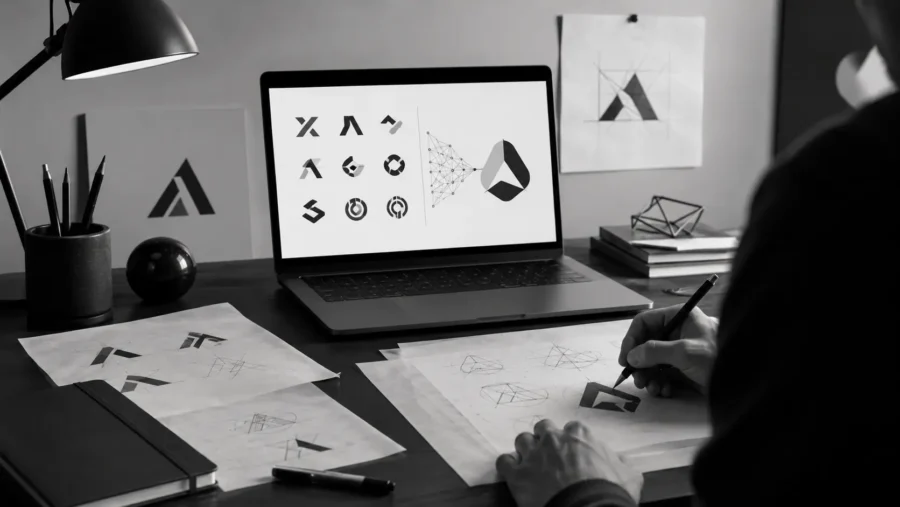
AI Logo Design is becoming an attractive option for many businesses. With just a few simple steps, a prompt describing the brand name, industry, preferred style, and one click, AI can generate multiple logo versions within minutes. For small startups, personal brands, or teams with limited budgets, this can feel like a breakthrough that helps save a lot of money.
But at Align, we believe a logo is not just a nice-looking image placed next to a brand name. It is an important part of the brand identity system. A logo needs to represent the business, connect with the target audience, work across different materials, stay recognizable at different sizes, and be distinct enough so the brand is not confused with competitors. A good logo should not only “look fine” in a beautiful mockup. It needs to work well on websites, business cards, proposals, social media, signage, packaging, email signatures, presentation decks, and other marketing materials.
So the real question is: can AI Logo Design fully replace designers and a professional branding process?
According to Align Agency, the answer is: not yet. There is no doubt that AI can be a powerful assistant for generating ideas, finding inspiration, saving time, and producing results that may feel “wow” to people outside the design industry. But to build a logo that is strategic, practical, distinctive, and aligned with the brand’s long-term direction, businesses still need designers or an experienced branding team.
In this article, Align Agency will break down what AI Logo Design is, what AI does well, where it still has limitations, when businesses should use it, when they should avoid relying on it, and what they should consider before choosing AI for logo design.
Can AI Logo Design Replace Designers?
Not yet. Simply put, AI Logo Design can support designers, but it cannot fully replace them.
AI can create many concepts, generate multiple options, suggest styles, help businesses explore early moods, and save time during the brainstorming stage. However, AI still has limitations when it comes to deeply understanding brand strategy, analyzing the market, creating exclusive logo directions, testing real-world application, checking differentiation, building a logo system, and developing a complete brand identity.
| Criteria | AI Logo Design | Designer / Branding Team |
|---|---|---|
| Idea generation speed | Very fast | Slower, but more selective and story-driven |
| Initial cost | Low | Higher depending on project scope |
| Understanding brand strategy | Still limited | Can deeply analyze customer behavior and build a logo story |
| Differentiation | More likely to repeat familiar ideas | Can build a unique design direction |
| Real-world application | Needs to be tested by the business | Designed for multiple channels and touchpoints |
| Logo system | Often missing | Includes primary logo, secondary logo, icon, mockups, and usage rules |
| Brand guideline | Often incomplete | Provides clear usage rules |
| Legal / ownership control | Terms must be checked carefully | Easier to control with a clear process |
| Best suited for | Brainstorming, quick concepts, mood exploration, design idea research | Brand strategy, full brand identity, long-term branding development |
There is a reason people say: more haste, less speed. AI can help you start faster in terms of quantity, but it is much harder for AI to replace designers in terms of quality.
What Is AI Logo Design?
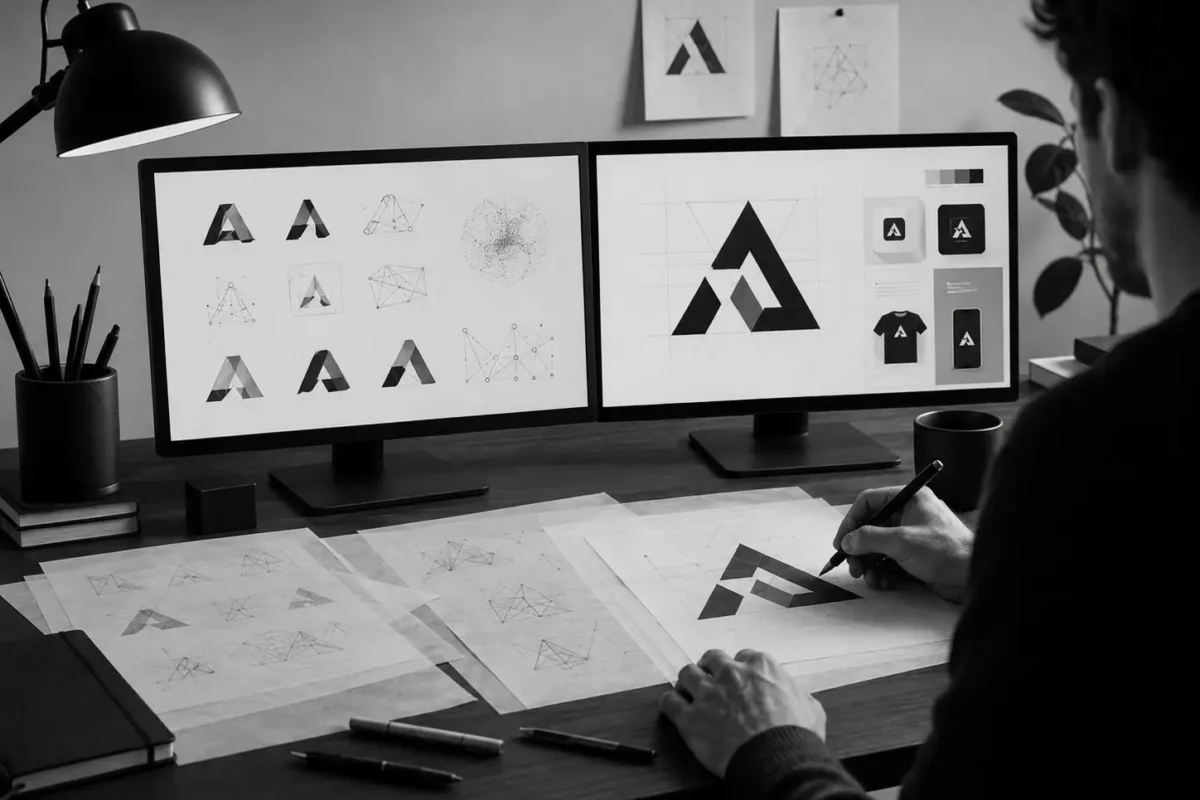
AI Logo Design is the use of artificial intelligence tools to create logos or logo concepts based on prompts, brand names, industries, colors, styles, or other inputs provided by the user.
Today, there are many AI logo maker tools, such as Canva AI Logo Maker and Adobe Express, that work like smart template-based systems. Users enter the brand name, slogan, industry, and preferred style, then the system generates multiple logo options based on its existing library. Other generative AI tools, such as ChatGPT, Gemini, and Claude, can help create images, symbols, typography ideas, or visual direction from descriptive prompts.
For example, a user may enter a prompt like:
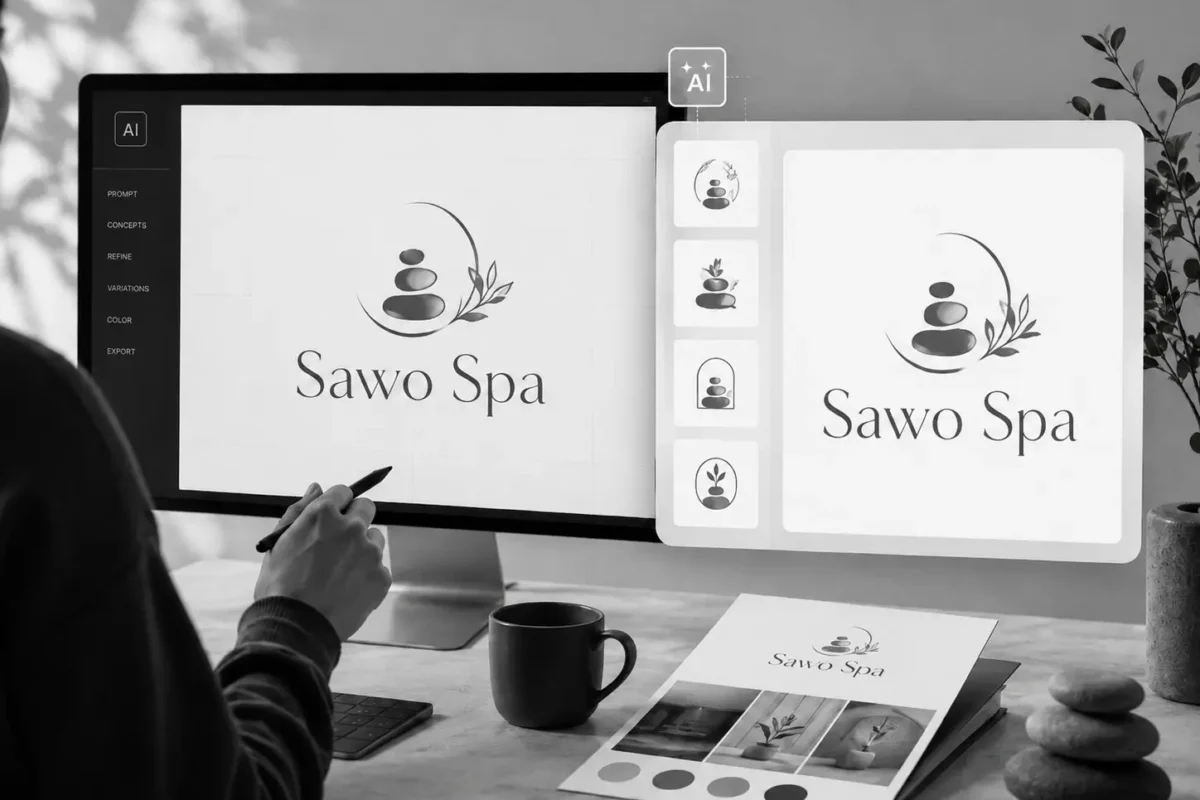
“Design a simple but premium logo in PNG format, using soft brown as the main color, a light serif typeface for the brand name Sawo Spa, and an organic, nature-inspired symbol with a sauna stone element.”
From there, AI can create several different variations. With more prompt refinement and idea adjustments, the user may be able to find a decent logo option that can be used. This is one reason AI Logo Design has become so popular. Non-designers may not be overly strict about design details. They simply need a basic logo they can use quickly without spending too much money, and AI does a good job of serving that type of user.
Why Is AI Logo Design So Appealing to Businesses?
AI Logo Design is appealing because it solves three major problems: time, cost, and accessibility.
For many new businesses, a logo is one of the first things they need. They need a logo to build a website, open social media accounts, create business cards, send proposals, design packaging, or register for an event booth. When the budget is still limited, paying for a full professional branding process may feel like a big investment.
AI makes the process feel simpler. You can try different styles, change colors, adjust icons, and see multiple options almost immediately. This is especially useful in the early stage when a business is still exploring what visual direction it likes.
AI Logo Design may be suitable for:
- Individuals who need a temporary logo
- Small projects or side projects
- Short-term events
- MVPs that need quick testing
- Teams that want to brainstorm visual direction
- Designers who want early idea references
- Businesses that want to explore different moods before investing in official branding
Another strength of AI is that it helps non-designers visualize style more easily. Instead of saying, “I want the logo to feel modern, not too tech, slightly premium, and minimal,” AI can quickly generate a few visual options so the team has something more concrete to discuss.
But this convenience also creates a risk: businesses may choose a logo just because it “looks nice” in the moment, without evaluating whether it is right for the brand in the long run.
What Does AI Do Well in the Logo Design Process?
AI is not useless in design. In fact, when used properly, AI can be a very helpful tool for designers and branding teams. AI can support designers in steps such as:
- Brainstorming initial ideas.
- Creating multiple style directions quickly.
- Exploring moods, shapes, icons, or symbols.
- Suggesting colors or visual themes.
- Creating visual references for stylescapes.
- Comparing different design directions.
- Helping designers move past the “blank page” stage.
- Creating rough concepts for internal discussion.
For example, Adobe Firefly positions its generative AI tools as a way to create and edit images, video, audio, and vector content. Adobe also describes its models as being designed to be commercially safer within its ecosystem [1]. This shows that AI is becoming a real part of the creative workflow, not just a short-term trend.
However, the important point is that AI should be treated as a tool, not the final decision maker. AI can create many options. But deciding which option is right, how it should be refined, which ideas should be removed, how the concept should become a system, and how it should be applied across the brand still requires design thinking.
AI can create many options for users, but designers decide which option is worth developing and how to adapt it for practical use, brand storytelling, and a long-term strategy.
That is the key difference between output and direction.
What Does AI Still Struggle With in Logo Design?
One of the biggest limitations of AI Logo Design is that AI does not truly understand a business the way a designer or branding team can. AI cannot schedule a founder interview, listen to the sales team explain customer pain points, study brand history, analyze competitors in the market, or fully understand the target audience. Even when you try to “explain” or provide information to AI, the result often stays at a decent average level and may struggle to create a direction that feels truly different or breakthrough.
AI can create a logo that “looks like the industry.” For example, a technology company may get a geometric symbol, a clinic may get a cross or leaf icon, and a fashion brand may get an elegant serif wordmark. But because of this, many AI-generated logos can feel familiar, safe, and slightly similar to something you have seen before.
Common limitations of AI-generated logos include:
- The logo looks nice but lacks a strategic idea.
- The symbol resembles many other brands.
- Typography is not refined enough.
- The logo is difficult to use at small sizes.
- There are no horizontal, vertical, icon, or lockup versions.
- There are no rules for spacing, color, light background, or dark background.
- Real-world application on websites, social media, and print is not tested.
- There is no clear brand story.
- Differentiation within the industry is not guaranteed.
- There may be usage rights or similarity concerns.
AI often generates results based on patterns it has learned. This is useful for creating something safe, but not always useful when a brand needs to stand out in a competitive market. With logo design, being different does not mean being strange. It means being intentional and strategic.
A Logo Is Not the Whole Brand
One reason many businesses are drawn to AI Logo Design is that they think the logo is the brand. Align has worked with many clients who initially thought logo design meant branding. They assumed that if the logo looked good, the brand identity was already complete.
But in reality, a logo is only one small but important part of a larger brand system.
A brand includes how the business is positioned, how it communicates, what images it uses, its colors, typography, layout, tone of voice, website, social media, proposals, presentations, signage, print materials, and the overall experience customers have with the business.
| Component | Role in the Brand |
| Brand strategy | Defines positioning, audience, value, and direction |
| Logo system | Creates the main recognition mark |
| Color palette | Builds emotion and consistency |
| Typography | Creates personality and readability |
| Graphic style | Builds a distinct visual language |
| Image direction | Guides brand imagery |
| Brand voice | Defines how the brand communicates |
| Brand guidebook | Helps the team use the brand correctly |
| Brand applications | Shows how the brand works on real materials |
An AI logo can solve only a very small part of this table. If a business wants to build a brand that is consistent, memorable, and trustworthy, the logo needs to live inside a larger identity system.
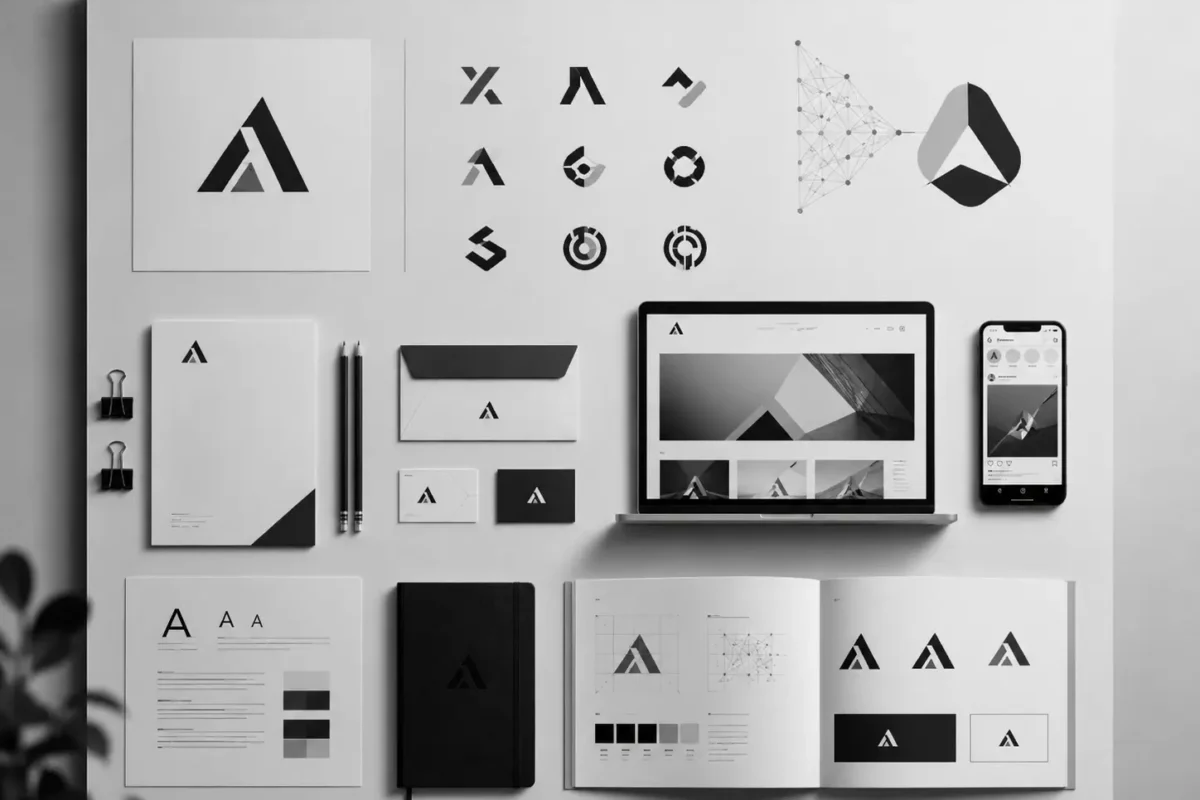
This is why Align’s Branding Process does not begin with “drawing a logo right away” or creating quick logos and five-minute logos. The process starts with understanding the business, meeting with the team, and asking the right questions to clarify goals, customers, and growth direction. From there, a fuller brand picture is built through stylescape, brand strategy, logo design, visual identity system, brand guidebook, and brand applications. The logo is important, but it does not stand alone.
Are There Ownership and Legal Risks With AI Logo Design?
This is where businesses should be careful.
Depending on the AI tool, plan, terms of service, and level of human involvement, usage rights for AI-generated logos can vary. Some tools allow commercial use, some have restrictions, some require a paid plan, and some terms may change over time. Before using an AI logo as the main brand identity, businesses should carefully read the tool’s terms of use.
On copyright, the U.S. Copyright Office has stated that works created entirely by AI without significant human creative input are generally not eligible for copyright protection under current law. However, human-created elements within a work that uses AI assistance may still be considered for protection [2].
Trademark is a different issue. A logo can be used as a trademark if it helps distinguish a business’s goods or services, but the business still needs to check similarity, distinctiveness, and registration requirements in the relevant market. The USPTO is the U.S. federal agency responsible for trademark registration and provides many resources related to trademarks [3].
Simply put, the fact that AI created a logo does not mean the logo is automatically safe for long-term use. Businesses should still check:
- Does the AI tool allow commercial use?
- Does the logo look similar to another brand?
- Does it use elements that are too common in the industry?
- Is it distinctive enough for trademark registration?
- Are vector files included?
- Could someone else generate a similar output?
- Has the logo been significantly refined by a human?
If the logo is only for a side project, the risk may be lower. But if the logo will become the main identity of a business, it is worth being much more careful.
When Can Businesses Use AI Logo Design?
AI Logo Design can be a reasonable option in certain situations.
Businesses may use AI when they:
- Need a temporary logo for an MVP.
- Need to brainstorm multiple early directions.
- Want to visualize a style before hiring a designer.
- Are working on a small, short-term, or internal project.
- Need a moodboard or quick inspiration.
- Want to test market reaction before investing in branding.
- Have designers using AI as an ideation tool.
In these situations, AI can save time and expand the range of options. But businesses should treat AI-generated logos as drafts or early concepts, not as the final identity for a long-term brand.
AI is very useful for asking: “What directions can we try?”
But AI should not be the final answer to: “How should our brand be recognized for the next several years?”
When Should Businesses Avoid Relying Only on AI for Logo Design?
Businesses should not rely only on AI if the logo will become the main identity and be used long term.
You should invest in a designer or branding team if:
- You are launching a serious brand.
- You need a logo that may be registered as a trademark.
- You need a complete brand identity system.
- You have many touchpoints such as website, signage, social media, proposals, and packaging.
- You need the logo to stand out in a competitive market.
- You are going through a rebrand or brand refresh.
- You need a brand guidebook for your internal team.
- You want the brand to feel professional and trustworthy.
- You do not want a generic or template-like logo.
In these cases, a beautiful logo is not enough. The business needs a strategic identity system that can work in real life.
This is especially important for websites. A logo needs to work well in navigation, favicon, mobile header, footer, social previews, and landing pages. If the logo is not designed as part of a system, it can create problems when applied to the digital experience. This is why Website Process and branding should be connected from the beginning.
What Is the Role of Designers When AI Can Create Logos?
The role of designers is changing, but it is not disappearing.
Many people used to think designers were simply people who “make things look nice.” But in branding, designers do much more than create visuals. Designers translate strategy into visual language, turn positioning into a visual system, and make sure the brand can be used consistently in the real world.
With AI, designers can use tools to generate ideas faster. But designers are still the ones who:
- Ask the right questions.
- Understand business goals.
- Analyze competitors.
- Define visual direction.
- Select concepts with potential.
- Refine typography and spacing.
- Test real-world application.
- Build a logo system.
- Create brand guidelines.
- Maintain consistency across multiple touchpoints.
Some leaders in design and technology have also suggested that AI can support creative workflows, but human taste, judgment, and creative direction remain important in design [4]. This is especially true in branding, where decisions are not only based on whether something “looks good,” but whether it feels right for the brand.
AI can help designers work faster. Designers help brands make better decisions.
How Should AI Logo Design and Designers Work Together?
The best approach is not choosing AI or designers. A better approach is using AI as a support tool inside a strategic process.
A reasonable workflow may look like this:
| Stage | How AI Can Support | What Designers / Branding Teams Need to Do |
| Discovery | Suggest early questions or moods | Interview, analyze goals, understand customers |
| Inspiration | Generate quick visual references | Curate, categorize, build stylescape |
| Concept | Create rough ideas | Evaluate, refine, develop direction |
| Logo design | Suggest shapes or symbols | Refine typography, balance, scalability |
| Visual identity | Suggest color or graphic mood | Build color, font, layout, and image direction systems |
| Brand guidebook | Support content outline | Write clear guidelines with usage rules |
| Applications | Create reference mockups | Design real business cards, social posts, decks, and website assets |
When used this way, AI does not replace designers. It gives designers and teams more material to think with.
The issue is not whether AI is being used. The real issue is who is directing the process and whether they have the ability to evaluate the output.
Checklist for Evaluating an AI Logo Before Using It
If your business is considering using an AI-generated logo, ask these questions first:
- Does the logo reflect the brand positioning?
- Is the logo different from competitors?
- Is the logo readable at small sizes?
- Does it work on both light and dark backgrounds?
- Does it have horizontal, vertical, icon, or favicon versions?
- Does it include vector files suitable for print?
- Has the typography been refined carefully?
- Does the logo look too much like a template or common style?
- Does it fit the target audience?
- Can it work on websites, social media, proposals, and signage?
- Does the AI tool allow commercial use?
- Has the logo been checked for similarity or trademark concerns?
- Is there a brand guidebook or usage rule system?
- Will the logo still fit the business in the next 3–5 years?
If many of the answers are “not sure,” the AI logo should be treated as an early concept, not something to use immediately as the main brand identity.
Ready to Build a More Professional Logo and Brand Identity?
Your logo should not be just a beautiful image. It should be part of a brand system that helps customers recognize, understand, and trust your business.
At Align, we help businesses build brand identity through brand discovery, strategy, logo design, visual identity systems, brand guidebooks, and real-world brand applications. Whether you are launching a new brand, refreshing your current identity, or building a more consistent brand system before redesigning your website, Align can help you create a brand that is clearer, more memorable, and easier to apply.
Explore Align’s Branding Process, see how brand strategy supports websites through our Website Process, or learn more about our SEO Process to build a more consistent digital presence.
References
- Adobe Firefly: Free Generative AI for Creatives
- The Verge: Purely AI-generated art can’t get copyright protection, says Copyright Office
- USA.gov: U.S. Patent and Trademark Office
- Business Insider: OpenAI’s Head of Codex Says AI Still Can’t Get Creative Design Right